
Know your honey · 3 min read
The wild rhubarb margin: Himalayan rhubarb and how it's pollinated
Himalayan rhubarb is a striking plant of dry, high slopes: huge leaves and tall spikes of small flowers. It's pollinated by both wind and insects. What it adds to honey, if anything, no one has studied.
By Akhil Verma, Co-founder, Not Your Beesness ·
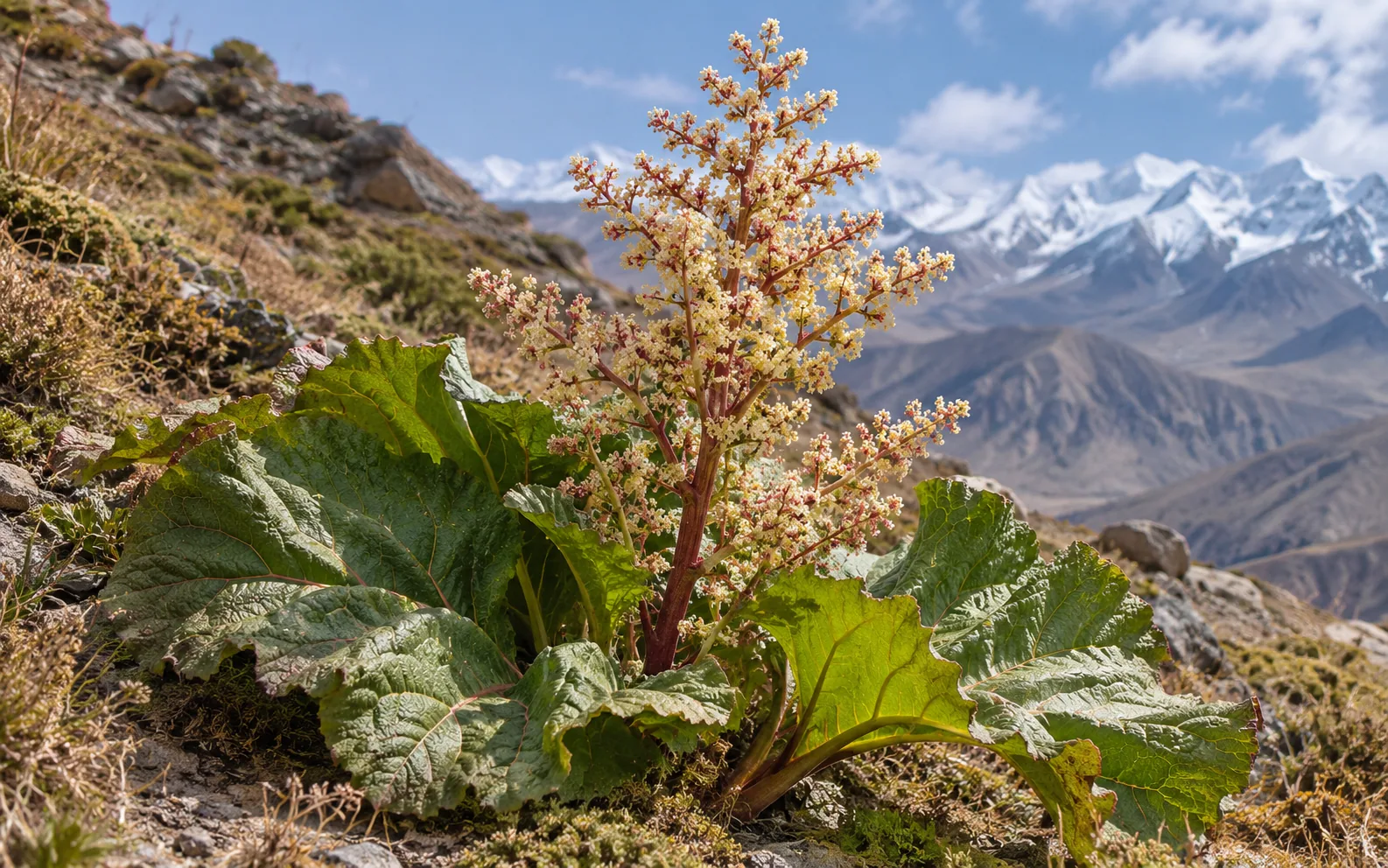
On a dry Himalayan slope, a clump of leaves as big as umbrellas, with a tall reddish spike rising from the middle, is hard to miss. That's wild rhubarb.
Quick answer: Himalayan rhubarb (Rheum webbianum) is a vulnerable medicinal herb of the north-western Himalaya, pollinated by both wind and insects. Its sour taste is in its stalks, not its nectar, and no study has looked for it in honey.
Himalayan rhubarb, Rheum webbianum, is a medicinal herb of the north-western Himalaya. Its roots are prized in traditional medicine, which has made it vulnerable in the wild. Its flowers are small and pale, packed along a tall stalk.
 Big leaves, tall spikes, and two ways to be pollinated.
How it's pollinated
A 2022 study of Rheum webbianum found:
- Two ways to be pollinated: by wind and by insects.
- Pollen first, then the stigma: each flower's stamens ripen before its stigma is ready, and the flower's parts move in ways that encourage cross-pollination between plants.
- It can also set seed with its own pollen when needed.
And bees?
The study confirms insects visit, but we found no record of which ones, or whether honeybees play a real part. In the high Himalaya generally, bee-pollinated plants become rarer with height, and flies and butterflies take over. The wild forget-me-not bloom.
What we can't claim
The topic we were given asks about "the sharp, complex elements found in high-cliff honey". We can't make that claim:
- Rhubarb's sharp taste is in its stalks, from acids in the plant. That's not nectar.
- No study has looked for rhubarb in Lahaul honey.
- There's no "high-cliff honey" in our range. Our Lahaul jar is a multiflora valley honey.
A myth worth clearing up
"A sour plant makes a sour honey." No. Nectar is mostly sugar and water. A plant's sourness lives in its leaves and stems, not in what bees collect.
A mountain ritual
If you find wild rhubarb on a trek, admire it but leave its roots: like many Himalayan medicinal plants, it's under pressure from digging. A photo is the best souvenir.
Common questions about Himalayan rhubarb
Is Himalayan rhubarb the same as garden rhubarb? They're relatives in the same genus. Garden rhubarb is grown for its stalks; Himalayan rhubarb is valued mostly for its roots.
Why is it vulnerable? Its roots are dug from the wild for medicine, and digging kills the plant.
Keep reading
- The high pass willow margins
- The alpine dandelion rush
- The wild thyme patches
- The wild angelica mystery
Part of our Lahaul honey guide.
Where this comes from
- Rheum webbianum: vulnerable medicinal herb of the north-western Himalaya; protandrous; pollinated by wind and insects (ambophilous); self-compatible: Wani et al., 2022, Frontiers in Plant Science
- Bee-pollinated plants declining with height in the Himalaya: Alpine ecology course, University of Zurich
- No source looks for rhubarb in Lahaul honey. The drawing is schematic.
Raw, unfiltered honey, bottled as it is. Sweet, from the flowers. Never from the stalks.
Meet the Lahaul jar, from ₹799 for ½ kg · or see what is coming next.
Not Your Beesness, sold on āsthālaya. Delivered across India.


