
Know your honey · 4 min read
The wild forget-me-not bloom: the little blue flower with a signal for insects
Forget-me-nots are tiny blue flowers with a yellow eye, and that eye is a signal. It tells insects where to land, then fades when the flower is done. High in the Himalaya, the insects reading it are often flies, not bees.
By Akhil Verma, Co-founder, Not Your Beesness ·
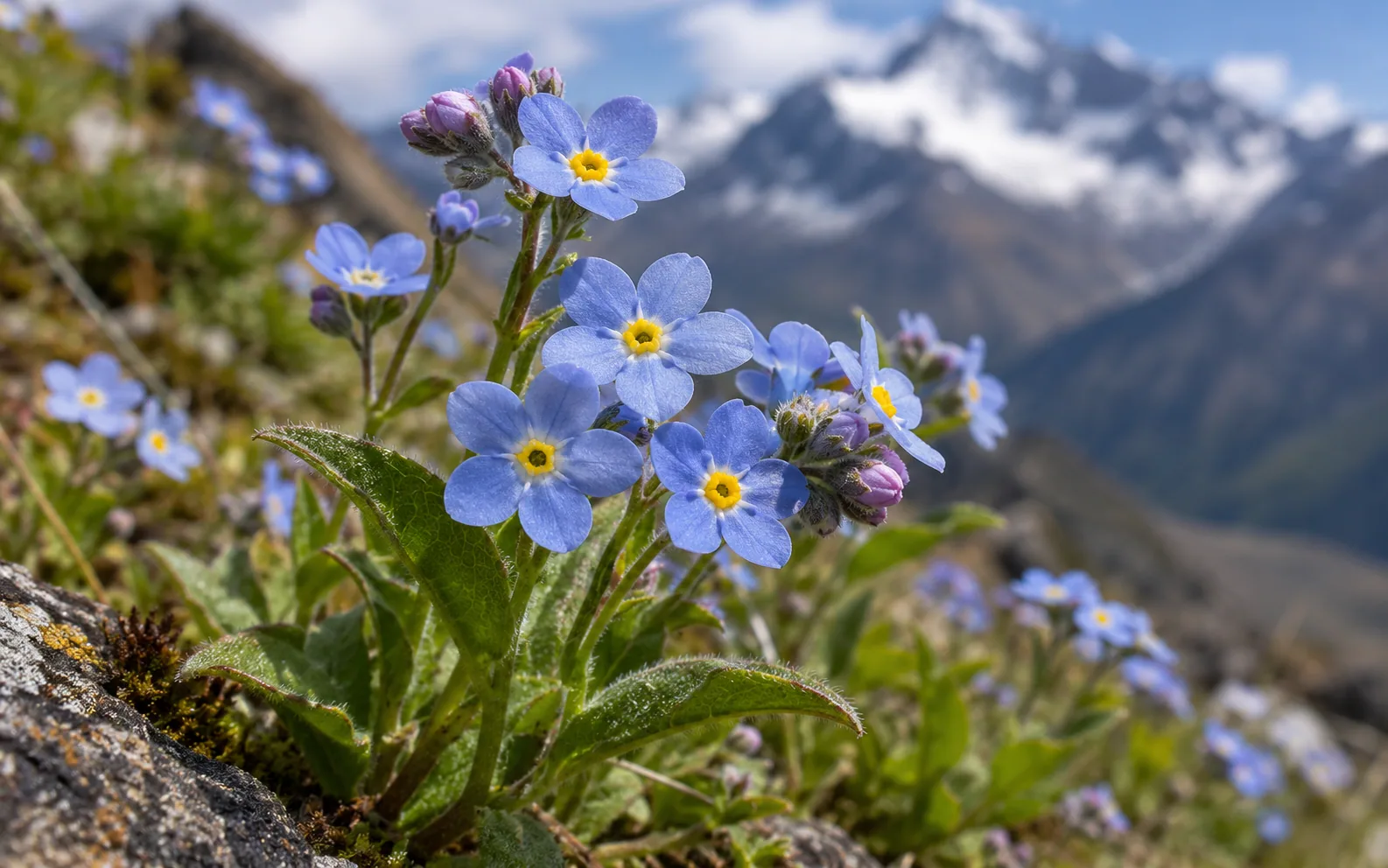
Look closely at a forget-me-not and you'll see a tiny yellow ring at its centre. It's not just decoration. It's a message.
Quick answer: A forget-me-not guides insects with a yellow ring that mimics pollen, then fades when the flower is done: hoverflies fed on 99% of visits to fresh flowers but 13% to faded ones. High in the Himalaya, flies often outnumber bees as visitors.
Forget-me-nots are small, five-petalled flowers, famously blue. They belong to the borage family, and in the Himalaya, close relatives grow in high meadows and rocky places. A botanical survey around Chandra Tal in Lahaul recorded an alpine forget-me-not among its plants.
 A yellow ring that says 'land here', then fades.
The yellow ring
The ring at the centre is a floral guide. Its bright yellow scales look like pollen-laden anthers, so insects aim straight for the middle of the flower, where the nectar and pollen are.
A flower that changes colour
In the wood forget-me-not, buds start pink and open sky-blue, as the chemistry inside the petals changes. Then, as a flower ages, its yellow ring fades.
Insects notice. In one study, hoverflies fed on 99% of their visits to fresh flowers with bright rings, but on only 13% of visits to older, faded ones. The fading ring tells them the flower is done, so they don't waste time.
Who visits high up?
In a study across the Nepal Himalaya, from about 3,000 to 13,500 feet, bees mattered less as pollinators the higher the plants grew, while flies and butterflies mattered more. So on a high Himalayan slope, forget-me-nots are as likely to be fed on by flies as by bees.
What we can't claim
The topic we were given asks about "sourcing from the dense blue carpets of early July". We can't claim it:
- We found no record of forget-me-not carpets as a bee source in Lahaul.
- At height, many of their visitors are flies, not honeybees.
- Only pollen analysis could show forget-me-not in a jar.
A myth worth clearing up
"Blue flowers make blue or 'floral' honey." No. Nectar isn't coloured like petals, and small flowers like forget-me-nots give only tiny amounts of nectar each.
A meadow ritual
Find a forget-me-not and compare a fresh flower with an older one. See the ring fade from yellow to pale. Then watch for a few minutes to see who visits. You may well spot a hoverfly before a bee.
Common questions about forget-me-not flowers
Why are they called forget-me-nots? The name is old and found in many languages, tied to legends of remembrance.
Do bees use forget-me-nots at all? Yes, small bees and honeybees visit them in many places, but each flower holds little nectar.
Keep reading
- The alpine dandelion rush
- The mountain lavender variant
- The alpine chicory bloom
- The wild creeper bloom
Part of our Lahaul honey guide.
Where this comes from
- Yellow coronal scales as an anther-mimicking floral guide: CORE, research record
- Wood forget-me-not changing from pink to blue with pH: Museum für Naturkunde Berlin, Naturblick
- Hoverflies feeding on 99% vs 13% of visits to pre- and post-change flowers: Nuttman & Willmer, University of St Andrews
- Bees declining and flies and butterflies rising as pollinators with height in the Nepal Himalaya (900–4,100 m): Dryad dataset
- Alpine forget-me-not (Eritrichium nanum) recorded around Chandra Tal and Suraj Tal: Dey et al., 2021, Check List
- No source records forget-me-nots in Lahaul honey. Heights converted from metres and rounded.
Raw, unfiltered honey, bottled as it is. From a short, bright mountain summer.
Meet the Lahaul jar, from ₹799 for ½ kg · or see what is coming next.
Not Your Beesness, sold on āsthālaya. Delivered across India.


