
Know your honey · 3 min read
The wild creeper bloom: ivy, the late flower bees love, and what we know about it in the hills
In Europe, ivy is one of the most important autumn flowers for honeybees. In one UK study, nearly nine in ten autumn pollen loads came from it. Near Kalka, its role has simply not been recorded.
By Akhil Verma, Co-founder, Not Your Beesness · · Updated
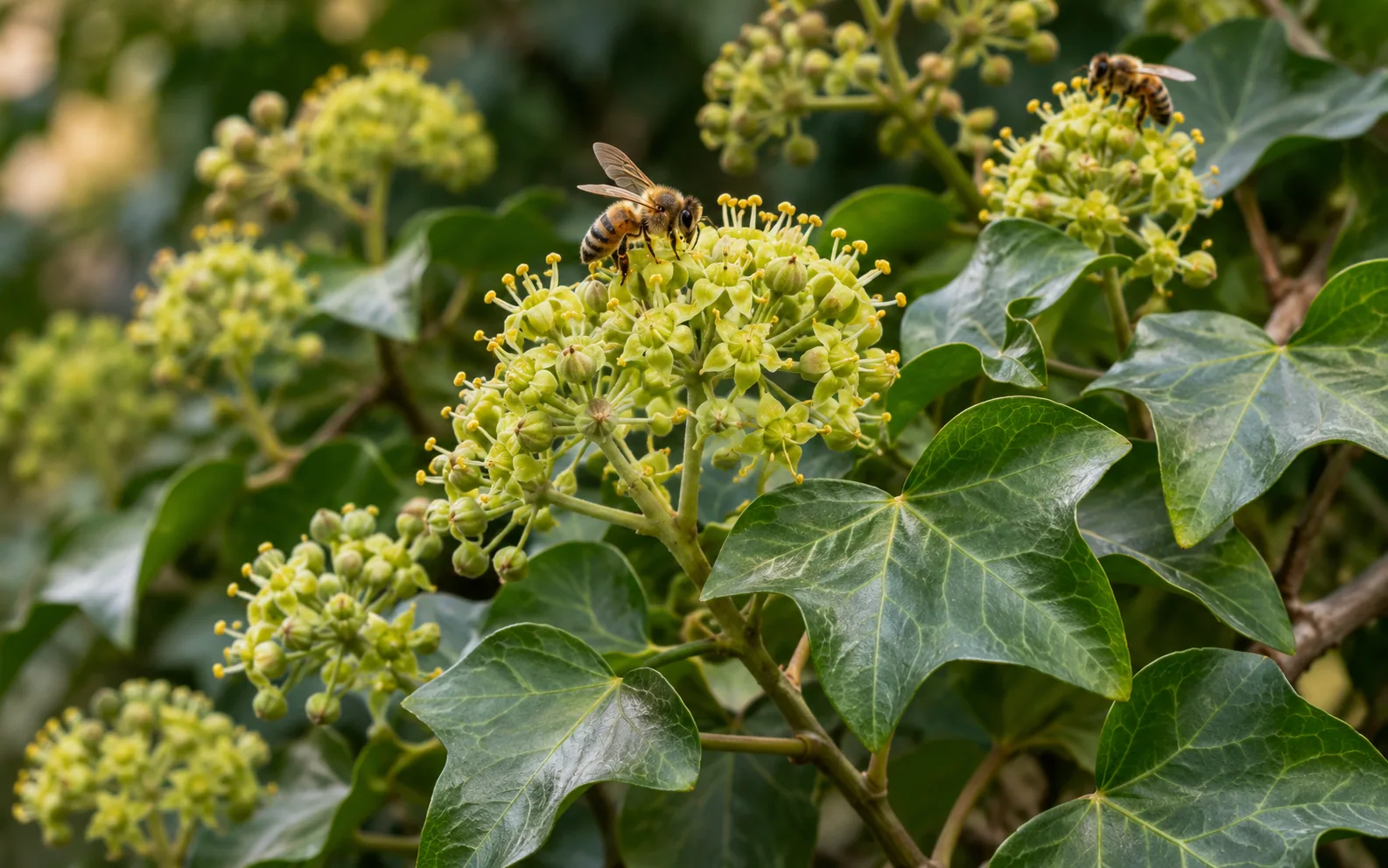
Most flowers are long gone by late autumn. Ivy is just getting started.
Common ivy, Hedera helix, is a climbing creeper that flowers from late summer into late autumn, in small round heads of greenish-yellow flowers. It looks plain. To bees in Europe, it is a feast.
 A late feast for bees in Europe. Unrecorded near Kalka.
What the studies say
Researchers at the University of Sussex in England watched honeybees through the autumn. They found:
- 89% of honeybee autumn pollen loads came from ivy.
- Most bees on ivy were collecting nectar only.
- Ivy nectar was about 49% sugar, which is rich.
They concluded that ivy is a key source of food for bees at a time when little else flowers.
What about the Shivalik hills?
There is a related species, Himalayan ivy (Hedera nepalensis), which grows in the Himalaya. It is a woody climber on trees and rocks in hill forests.
But we have to be honest: we found no record of how much it grows or flowers around Kalka, or whether bees there use it. So we can't tell you that ivy is in our honey, or what it would add.
What we can say is that the foothill autumn has its own late flowers, from scrub and forest-edge plants. The autumn transition and the October honey posts cover them.
Why late flowers matter
As the year cools, bees need food to build stores for winter. A late nectar flow, from ivy in Europe or from autumn scrub in the foothills, helps a colony go into the cold months strong. The winter slowdown explains what happens next.
A myth worth clearing up
"Ivy is just a pest on walls and trees." Not to bees. Ivy can be a nuisance on buildings, but to pollinators it is one of the most valuable late-season plants. Some researchers call it a keystone plant for autumn insects.
An autumn ritual
On a cool October evening, look at an old wall or tree covered in creeper. If it is flowering, watch for a minute: you may see bees, wasps and hoverflies all at work. Then go in for a warm cup of milk with a spoon of honey stirred in once it has cooled a little.
Common questions
Is ivy honey a thing? In parts of Europe, yes, and it is known for setting very fast. It is not something sold in India.
Is ivy poisonous? Ivy berries and leaves should not be eaten. Honey from bees that visited ivy is a different matter: it is an ordinary food.
Keep reading
Part of our Kalka honey guide.
Where this comes from
- 89% of autumn pollen loads from ivy, most foragers taking nectar only, nectar about 49% sugar: Garbuzov & Ratnieks 2014, University of Sussex repository
- Ivy's flowering season and value to insects: Wikipedia, Hedera helix; National Botanic Garden of Wales
- Himalayan ivy: Wikipedia, Hedera nepalensis
- No source records ivy's flowering or use by bees near Kalka. That gap is why the post makes no such claim.
Raw, unfiltered honey, bottled as it is. From the foothill year, late flowers and all.
Find your Kalka jar, from ₹499 for ½ kg · or see what is coming next.
Not Your Beesness, sold on āsthālaya. Delivered across India.


