
Know your honey · 5 min read
The autumn transition: where dark, resinous honey comes from
As the rains ease and the foothills turn to autumn, people start asking for the dark stuff: bold, woody, almost resin-like honey. Here is where that colour and taste really come from, and how to know what you are buying.
By Akhil Verma, Co-founder, Not Your Beesness · · Updated
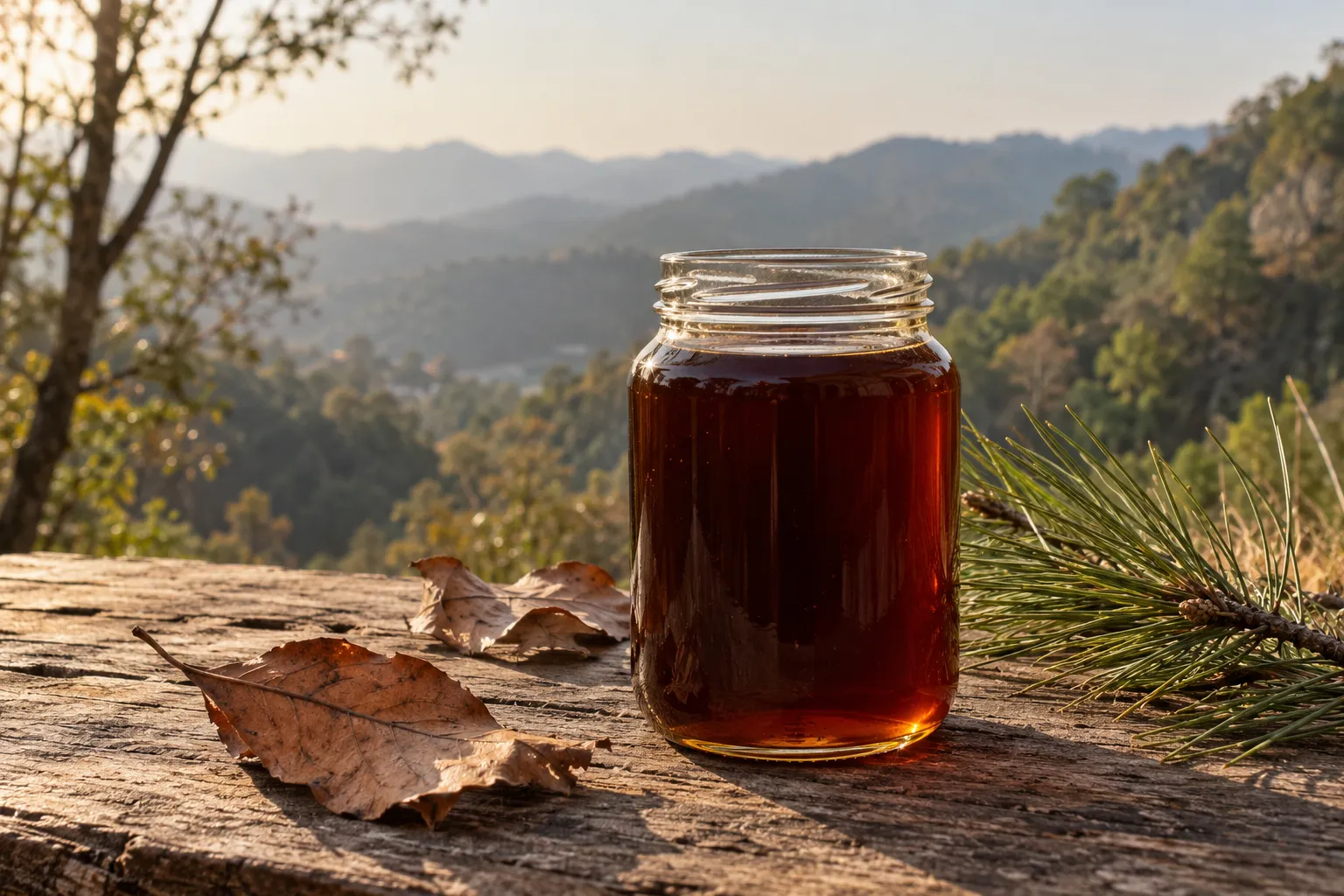
There is a kind of honey that tastes less like flowers and more like a forest: dark, woody, a little bitter at the edges, almost like resin.
People call it "bush honey", "forest honey" or "jungle honey", and once the autumn chill arrives in the foothills, it is the honey many families start asking for. It goes beautifully with a winter breakfast.
But what actually makes a honey dark and resinous? The answer is simpler than most labels admit.
 Colour starts with the source. Honeydew honey, the woody forest kind, has to say so on its label.
The autumn turn in the foothills
As the monsoon fades in September, the Kalka foothills change gear. The heavy rains stop, the scrub is green and soaked, and ber bursts into tiny green-yellow flowers. After the lean weeks of the monsoon, the bees finally have something to work again. Here is what the rains do to the bees.
Ber honey is usually described as golden amber, sweet and a little tangy. So the autumn turn does not automatically mean dark honey. For truly dark, woody honey, you have to look to two other sources: certain flowers, and the forest itself.
Source one: dark flowers
Colour starts with what the bees gathered. Some flowers give pale honey, others give dark.
Look at our own honeys, from light to dark:
- Kalka: warm and golden, from the foothill scrub and orchards. In the jar now.
- Eucalyptus: amber, with a warm, slightly herbal note. Coming.
- Lahaul: deeper, amber and intensely aromatic, from alpine thyme, sea buckthorn and clover. In the jar now.
- Wild forest: dark and full, gathered from wild hives, and never the same twice. On our list.
- Jamun: one of the darkest honeys there is, rich with a slightly tangy finish. Coming.
Same bees, same care. The colour comes from the source.
Source two: the forest, and "honeydew"
Here is the part most labels skip.
That woody, resin-like, less-sweet taste people love in "forest honey" often comes from something called honeydew. Honeydew is not made from flowers at all. On some trees, tiny sap-sucking insects leave sweet, sticky drops on the leaves and needles. Bees gather those drops and turn them into honey, just as they would with nectar.
Honeydew honey is typically:
- Dark, often much darker than flower honey.
- Less sweet, with a woody, malty, sometimes resin-like taste.
- Slow to set: it tends to stay runny much longer than most flower honeys.
Forests of pine, fir and oak are classic sources. More on honeydew in the hills around Kalka.
What the label has to say
This is a trust point worth knowing.
Under FSSAI rules, honey made from honeydew must be named on the label as "Honeydew Honey". If it is a mix, it must say "Blend of Honeydew Honey and Blossom Honey". So a jar sold as dark, resinous "forest honey" should tell you which it is.
If a jar promises a dark, woody forest taste but the label tells you nothing about where it came from, ask questions.
Two myths about dark honey
"Dark honey is burnt or fake." Not on its own. Jamun honey and honeydew honey are naturally dark. Be aware, though, that heat and long storage also darken honey. That is why colour alone tells you very little. The source, the place and the label tell you more.
"Honey that never sets must be fake." Not true. Honeydew honey and some flower honeys stay runny for a long time. And some fake honey sets too. Why honey sets, or does not.
Dark honey on an autumn table
Bold honey suits the cooler months:
- With makki ki roti and white butter, a drizzle where you might use gur.
- Over thick dahi with walnuts, for a quick winter breakfast.
- Daadi's adrak aur shahad, a spoon of honey with fresh ginger juice when the first cold arrives. Tradition, not medicine. Always stirred in warm, never boiling. (Here is why.)
And honey is not for babies under one.
Common questions
Do you sell dark autumn honey from Kalka? Not as a separate jar. Our Kalka jar is warm and golden, and like all multiflora honey its colour can shift a little from batch to batch. For our deepest jar today, try Lahaul.
Is your wild forest honey a honeydew honey? It is still on our list, so we can't say yet. When it arrives, the label will say exactly what it is, as the rules require.
Is dark honey healthier? We sell honey as honey, not as medicine. Choose the colour and taste you enjoy.
Keep reading
- The pine foothill margin
- The Shivalik oak margins
- The October cleansing
- Two places, two jars
- The wild buckwheat fields
Part of our Kalka honey guide.
Where this comes from
- Honeydew honey is darker, less sweet and slower to set than blossom honey: Honey Traveler; Airborne Honey; balsamic, resin-like fir honeydew: Parco Foreste Casentinesi
- FSSAI naming rules for "Honeydew Honey" and blends: Food Safety and Standards (Food Products Standards and Food Additives) Regulations, Reg 2.8.3
- Ber honey described as golden amber, sweet and tangy: seller listing
- Our honeys' colours and descriptions: Not Your Beesness, Our honeys
Raw, unfiltered honey, bottled as it is. Every jar named for the place it came from.
Find your jar · or give both places in one box: the Diwali gift box.
Not Your Beesness, sold on āsthālaya. Delivered across India.


