
Know your honey · 4 min read
The sweet clover cycle: what senji brings to the bees, and what it can't promise your jar
Senji, the little yellow sweet clover of North Indian fields, is a real bee plant. A 'crisp finish' in a Kalka jar is a promise nobody can honestly make. Here is what we do know.
By Akhil Verma, Co-founder, Not Your Beesness · · Updated
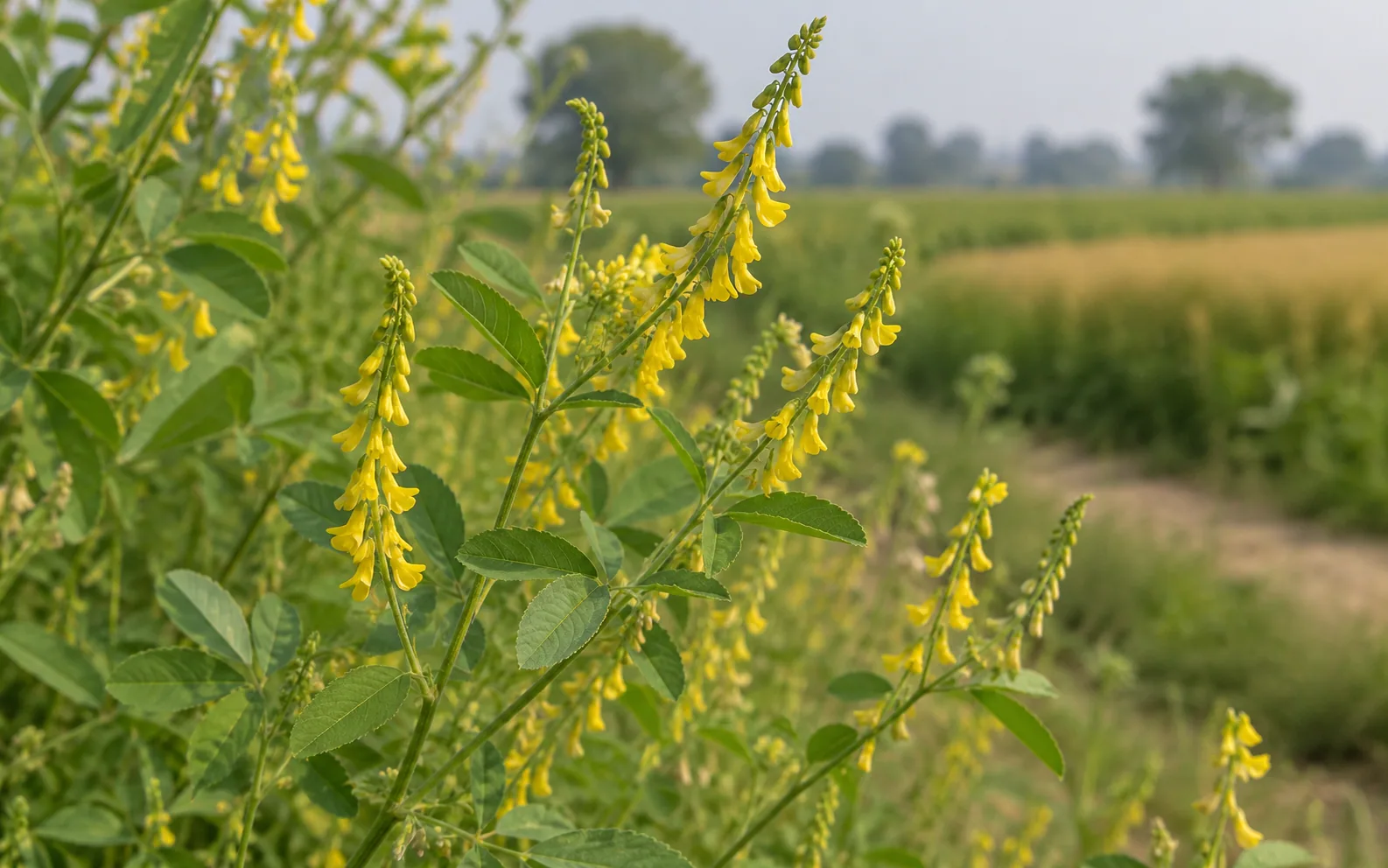
Walk the edge of a wheat field in North India and you will probably step on senji without noticing it.
It is a small, scruffy plant with three-part leaves and thin spikes of tiny yellow flowers. Farmers call it a weed. Bees treat it as a meal. Its family name gives it away: this is sweet clover, Melilotus, a plant that beekeepers in other countries prize.
 A real bee plant. Not a promised flavour.
Meet senji
The sweet clover of the Indian plains is Melilotus indicus, small-flowered or Indian sweet clover. It grows in fields, along canals and on waste ground, and it is recorded as a nectar source for bees. It is a cousin of the white and yellow sweet clovers grown as bee forage in North America and Europe.
The name "sweet" comes from its smell. Crush a sprig and you get a hay-like, faintly vanilla scent, from a natural compound called coumarin.
What sweet clover honey tastes like (abroad)
Where sweet clover is grown in large fields, beekeepers can harvest a honey led by it. That honey is usually described as light in colour, mild and gently sweet, with a vanilla-like note.
That description comes from large single-crop fields in other countries. In the Shivalik foothills, senji is one small plant among many.
So, a "crisp finish" in our jar?
We would love to write that line. We can't, for three reasons:
- Nobody has tasted for it. No panel has described senji's mark on Kalka honey.
- Nobody has measured it. Only pollen analysis can tell how much senji went into a batch. Our honey is multiflora: many flowers, none leading.
- We don't know its local season. Senji's flowering months around Kalka are not well recorded.
What we can say is simpler. Small field flowers like senji are part of the mix that makes foothill honey what it is. The grassland blooms post covers the other little clovers and field flowers.
A myth worth clearing up
"Clover honey is always the lightest, mildest honey." Often, not always. A clover-led honey abroad is usually pale and mild. A multiflora honey with some clover in it will taste of the whole mix. Judge a jar by tasting it, not by the flowers on its label.
A daadi-style ritual
Next time you are near a field edge, look for the yellow spikes, pick a sprig and smell it. That hay-and-vanilla scent is the "sweet" in sweet clover. Then go home and taste a spoon of honey slowly, the way you would a good chai. Name what you find.
Common questions
Is senji the same as the clover in lawns? No. Lawn clover is usually white clover (Trifolium), with round flower heads. Senji is Melilotus, with thin flower spikes.
Is sweet clover honey safe? Yes. The coumarin is in the plant, and honey is a normal food. As with all honey, not for babies under one.
Will my jar set like ghee? It might. Most raw honey crystallises in time. Here is why that is natural.
Keep reading
Part of our Kalka honey guide.
Where this comes from
- Melilotus indicus, its range and habit as a field weed: Wikipedia, Melilotus indicus
- Melilotus species as nectar plants and forage: PROSEA, Melilotus (Pl@ntUse)
- Sweet clover honey described as light, mild and vanilla-like: Bee Inspired Goods, What is sweet clover honey?
- No source describes senji's flavour in Kalka honey, or its local flowering months. Those gaps are why the post makes no such claim.
Raw, unfiltered honey, bottled as it is. Many small flowers, one honest jar.
Find your Kalka jar, from ₹499 for ½ kg · or see what is coming next.
Not Your Beesness, sold on āsthālaya. Delivered across India.


