
Know your honey · 3 min read
The footpath blossoms: the humble weeds that keep bees going
We pull them out, mow them down and step over them on the footpath. But when the big flowers fade, the bees turn to the weeds. In one Haryana study, weeds were the largest group of plants that carried bees through the lean months.
By Akhil Verma, Co-founder, Not Your Beesness · · Updated
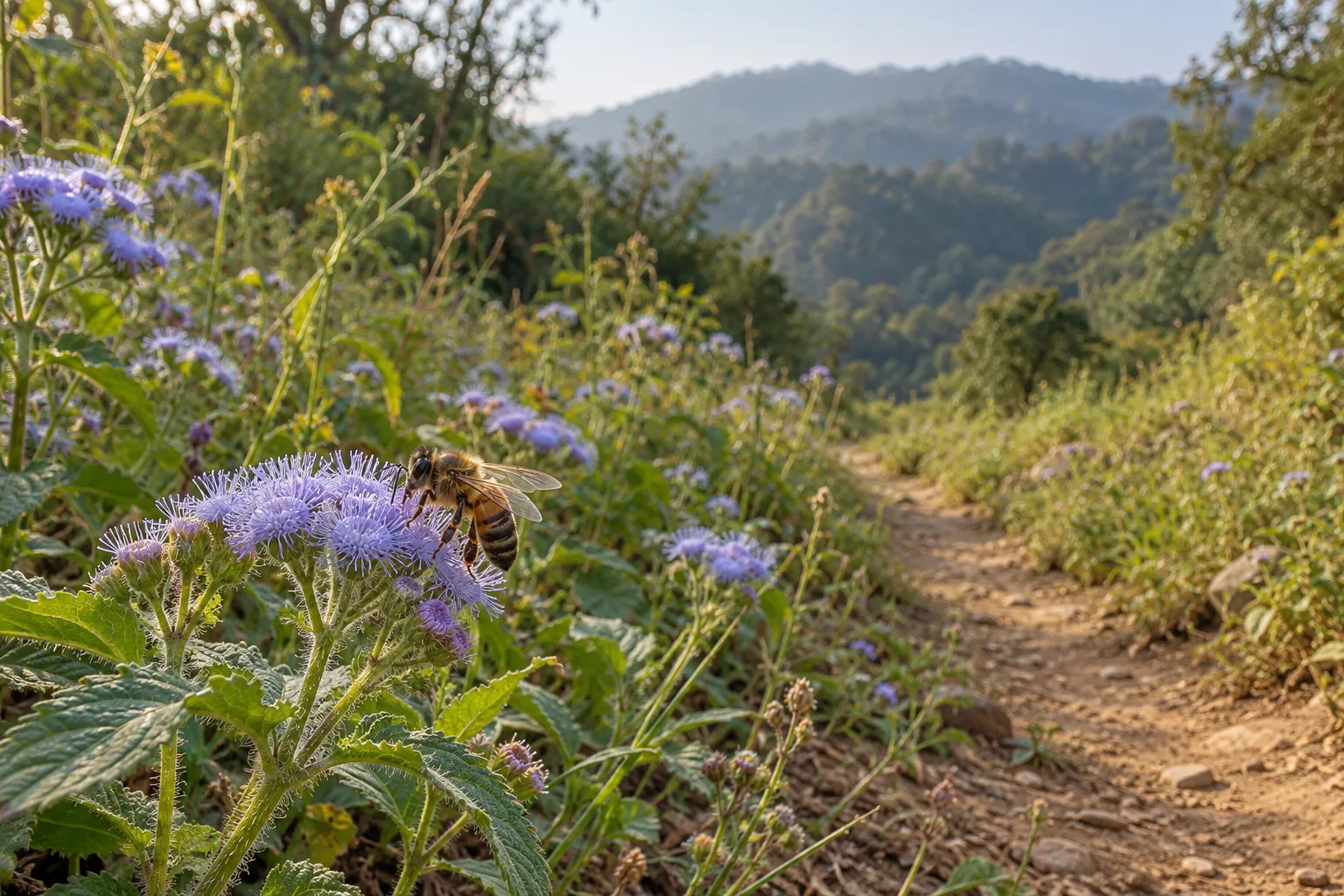
The plants that save the foothill bees in a bad summer are not the famous ones. They are the scruffy little flowers growing on the footpath.
When the spring flow is over and the monsoon sets in, bees can go hungry for months. That is when the weeds step in.
 Weeds were the largest group of plants that fed bees through the lean months.
What the study found
Researchers followed honeybees near Kaithal in North Haryana through the June-to-October dearth in 2017 and 2018. They found 71 kinds of plants keeping the bees going, and the biggest group, 23 of them, were weeds. Then came garden flowers (16) and plantation trees (12).
They also found that most of the plants bees visited most often gave them pollen rather than much nectar: protein to keep raising young bees through the lean months.
A few footpath favourites
Parthenium and motha (nut-grass). Both are notorious pests: parthenium is a health hazard for people and cattle. Yet a Himachal study found both in full bloom during the monsoon dearth, with honeybees foraging on them keenly.
Ageratum (goatweed). Lilac tufts on field edges, and a key autumn pollen source in a Kumaon study.
Guma (Leucas). Small white flowers in rings, visited by 21 kinds of bees and wasps in a Karnataka study, which suggested planting it along field edges to help bees in lean times. The wild mint carpet.
What it means for your jar
Weeds mostly keep colonies alive and growing through the lean months, rather than filling honey jars. Strong colonies in autumn mean a strong spring, and spring is when the foothills make most of their honey. Our Kalka jar owes a little to the footpath.
A myth worth clearing up
"A tidy field is good for bees." Not always. A strip of flowering "weeds" along a field edge can be the difference between a hungry colony and a healthy one. That is not a case for parthenium, which is harmful, but for leaving harmless wild flowers alone.
A small ritual
Next time you weed the garden, leave a corner of harmless wild flowers for the bees. Then reward yourself with a spoon of honey in your evening tea, stirred in once it is warm. Honey is not for babies under one.
Common questions
Is parthenium good for bees, then? Bees use it in hard times, but it is harmful to people and animals. It should not be encouraged.
Which weeds are best to leave? Harmless natives like guma and other small wild flowers. Ask a local naturalist.
Keep reading
Part of our Kalka honey guide.
Where this comes from
- 71 plants in 31 families during the June–October dearth near Kaithal, with weeds the largest group (23): Rathee, Chaudhary and Dalal, Indian Journal of Entomology, 2023
- Parthenium and motha (Cyperus rotundus) in full bloom and foraged in the monsoon dearth (Himachal Pradesh): Biosciences Biotechnology Research Asia
- Ageratum as an autumn pollen source (Kumaon): Geophytology, 1996
- Guma (Leucas aspera): FAO AGRIS
Raw, unfiltered honey, bottled as it is. With a quiet thank-you to the weeds.
Find your Kalka jar, from ₹499 for ½ kg · or see what is coming next.
Not Your Beesness, sold on āsthālaya. Delivered across India.


