
Know your honey · 4 min read
The wild angelica mystery: the rare Himalayan herb that needs protecting
Himalayan angelica is a tall, celery-scented herb of the high valleys, with big umbrellas of tiny flowers. It is also endangered. That makes it a plant to protect, not a honey source to boast about.
By Akhil Verma, Co-founder, Not Your Beesness ·
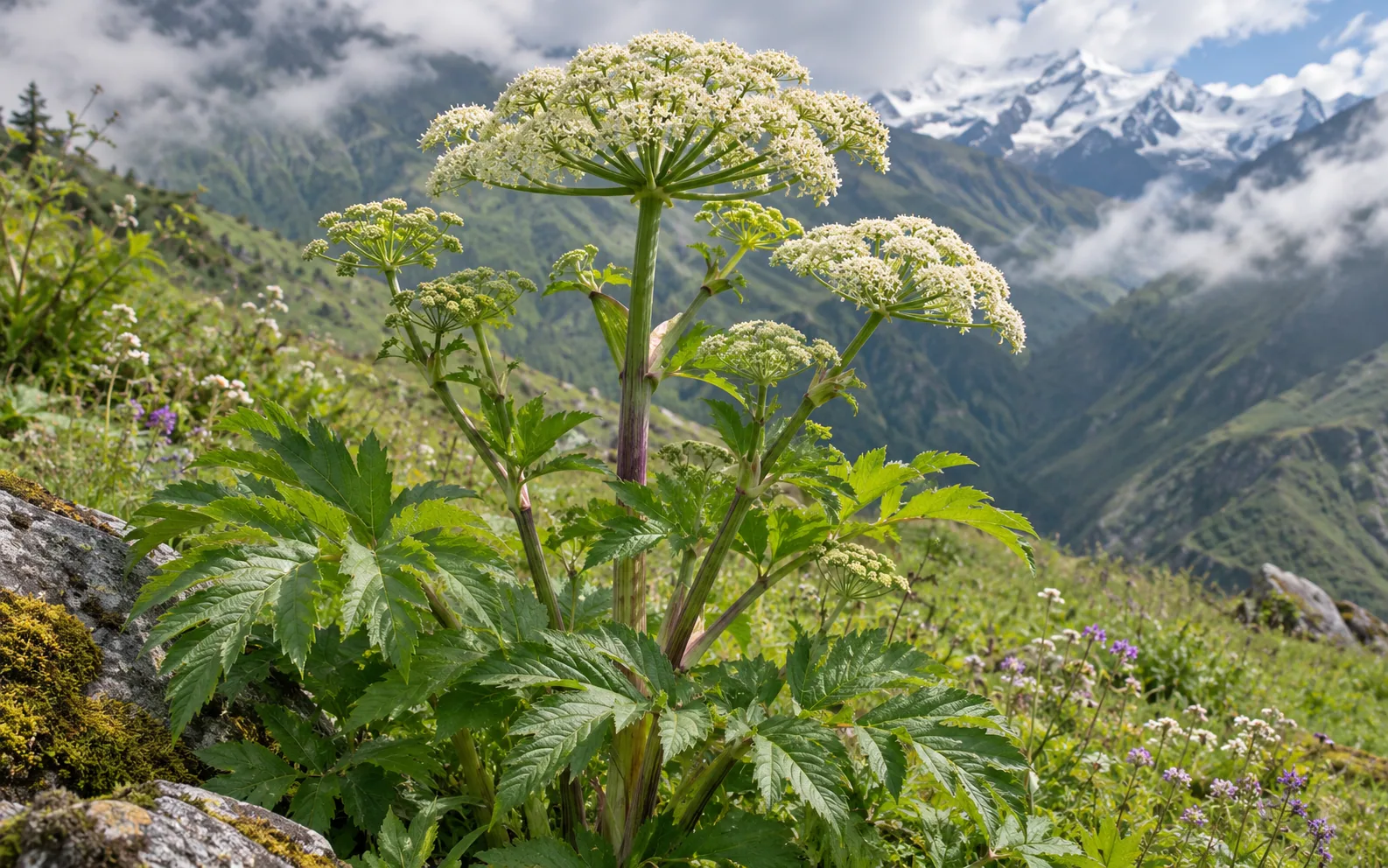
Crush a leaf of wild angelica and it smells like celery with a sweet, musky edge. In the western Himalaya, that scent has made it a target.
Quick answer: Himalayan angelica is an endangered, celery-scented herb of the hills at about 7,900–11,800 ft, its wild population down about 70% in ten years. A rare plant can't be a major honey source, and we found no record of it in Lahaul.
Himalayan angelica, Angelica glauca, is a tall herb of the high hills, a cousin of carrot, coriander and caraway. Its aromatic roots are dug up for traditional medicine and as a spice. That demand has pushed it into serious trouble.
 A rare mountain herb. Admire it; leave its root in the ground.
A plant in trouble
- It is listed as Endangered on the IUCN Red List.
- Its wild population is reported to have fallen by about 70% in ten years.
- The main reason: uprooting. Harvesting the root kills the whole plant.
Where it grows
Himalayan angelica grows at about 7,900 to 11,800 feet, on grassy, rocky slopes and at the edges of sub-alpine forest. In Himachal, it is recorded from valleys including the Parvati and in Chamba. We found no record placing it in Lahaul itself.
Who visits its flowers?
Angelica flowers grow in big, open umbels: flat umbrellas of tiny blooms that almost any insect can reach. Studies of a European angelica found more than 70 insect species visiting its umbels, with flies and beetles doing most of the pollinating. Bees visit too, but they aren't the main guests.
What we can't claim
The topic we were given calls angelica "one of Lahaul Valley's rarest herbal pollen sources". Two problems:
- We found no record of it in Lahaul.
- A rare plant can't be a major source of anything. Bees need large numbers of flowers to shape a honey.
So we make no angelica claim for our Lahaul jar. The honest message is simpler: if you see this plant, protect it.
A myth worth clearing up
"Rare plants make rare, special honey." No. For a flower to show up in honey, bees need lots of it. Rare plants, by definition, can't provide that.
A mountain ritual
If you trek in the hills and find a tall, sweet-smelling umbel plant, photograph it and leave it. Many medicinal Himalayan herbs are disappearing because people dig them up "just one at a time".
Common questions about Himalayan angelica
Is Himalayan angelica the same as European angelica? They are related species in the same genus. European angelica is the one used in liqueurs and candied stems.
Can angelica be farmed instead of harvested wild? Yes. Researchers in Himachal have tested growing it, which is one way to take pressure off wild plants.
Keep reading
Part of our Lahaul honey guide.
Where this comes from
- Range in Himachal (Parvati valley, Chamba), 2,400–3,600 m, grassy rocky slopes and forest edges: ENVIS/FRLHT species profile
- IUCN Endangered; wild population down about 70% in ten years; root harvesting: Temperate Plants Database
- Over 70 insect species on Angelica sylvestris, mostly flies as pollinators: University of Warsaw repository; flies and beetles across populations: PubMed Central, 2018
- Cultivation trials in the Parbati valley, Kullu: Journal of Tropical Agriculture
- No source records angelica in Lahaul or in its honey. Heights converted from metres and rounded.
Raw, unfiltered honey, bottled as it is. From mountains worth protecting.
Meet the Lahaul jar, from ₹799 for ½ kg · or see what is coming next.
Not Your Beesness, sold on āsthālaya. Delivered across India.


