
Know your honey · 3 min read
Beyond the Rohtang Pass: entering Lahaul, the high cold desert
Drive north from Manali, climb past 13,000 feet, and the green of Kullu falls away behind you. On the other side is Lahaul: a high, dry valley the monsoon barely reaches. This is where our Lahaul jar comes from.
By Akhil Verma, Co-founder, Not Your Beesness · · Updated
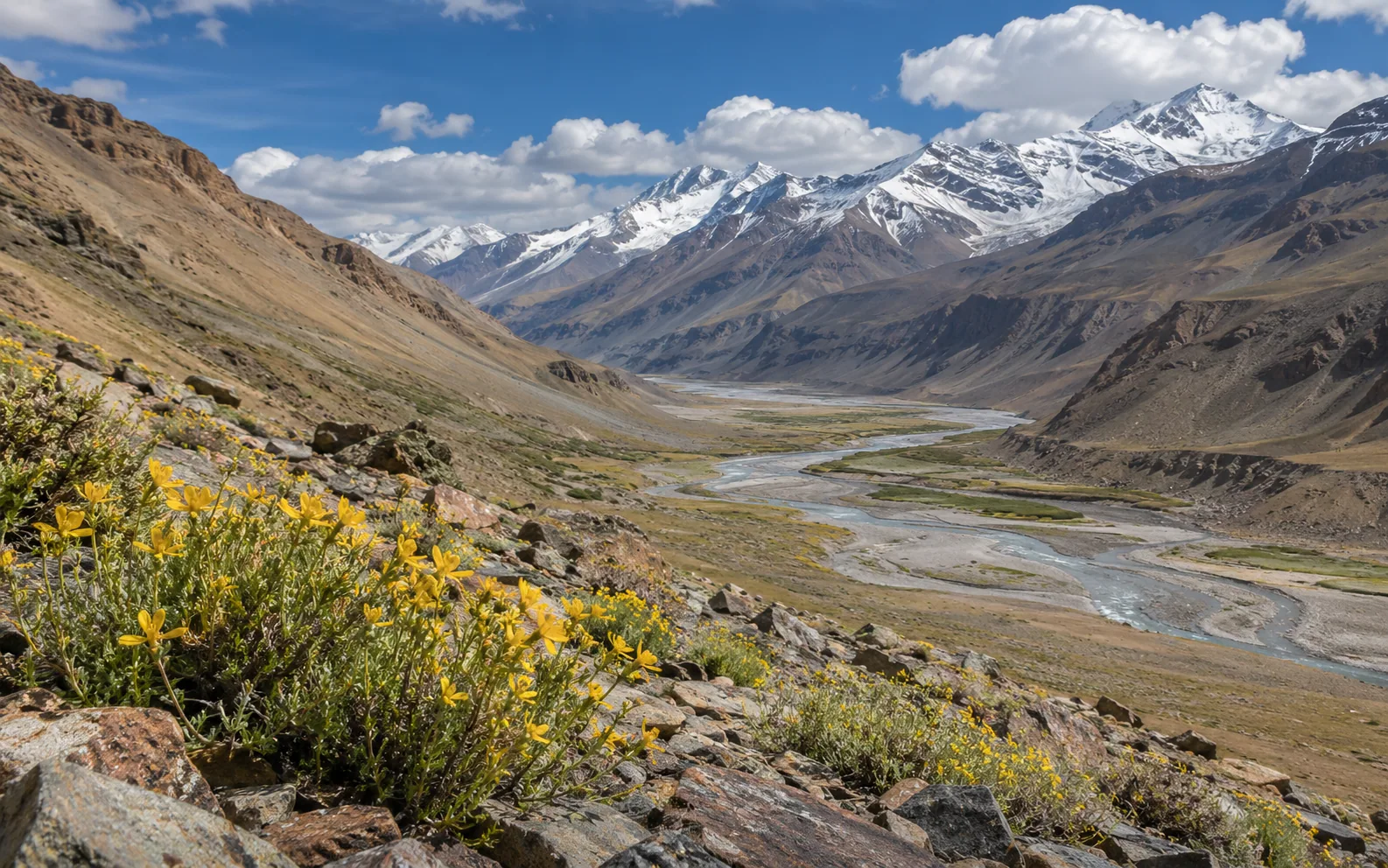
Stand at the top of Rohtang Pass on a clear day and you can see two different worlds.
Behind you, to the south, the Kullu valley is green, forested and wet. Ahead, to the north, the mountains turn bare and brown. That is Lahaul, and the line between the two is not an accident.
 Over the pass, the monsoon stays behind.
The wall that stops the rain
Rohtang Pass sits at about 13,050 feet on the Pir Panjal range. When monsoon clouds blow up from the plains, the range catches most of their rain on the Kullu side. Very little gets over.
North of the range lies a rain shadow. Lahaul gets little or no monsoon rain, and its winters bring snow instead. That is why it is called a cold desert: not because it is sandy, but because it is cold and dry.
A valley above 10,000 feet
Keylong, Lahaul's main town, sits at about 10,100 feet. The valley floors run around 10,000 feet and higher. Summers are short and bright. Winters are long and snowbound.
Cut off, then connected
For generations, the road over Rohtang closed with the first heavy snow, from about November to May, and Lahaul was cut off for months.
In October 2020, the Atal Tunnel opened beneath the pass. A crossing that once took hours over the top now takes about half an hour underneath. Winter storms can still block the roads, but the valley is no longer sealed off for half the year.
What this means for honey
Everything about Lahaul honey begins with this geography:
- Little rain means the green comes from glacier water, led to the fields by hand. The glacial stream nectar.
- High altitude means one short summer for flowers and bees. The Lahaul summer rush.
- Different plants from the Kalka foothills, which is why our two jars taste so different. Two places, two jars.
A myth worth clearing up
"Himalayan honey all comes from the same mountains, so it all tastes the same." No. A single mountain range holds wet forests and dry deserts a few hours apart. Lahaul and Kullu share a pass, not a climate.
A travel ritual
If you ever cross into Lahaul, stop at the tunnel's north end and look around. Notice how quickly the trees thin out and the light sharpens. Then, at home, open a Lahaul jar and taste it slowly. That short, bright summer is in there.
Common questions
Is Lahaul the same as Spiti? They form one district, Lahaul and Spiti, but they are different valleys. Spiti lies farther east and is drier still.
Can I visit Lahaul in winter now? The Atal Tunnel keeps it far more reachable than before, but snow can still close roads for days. Check conditions before you go.
Keep reading
- The glacial stream nectar
- The glacial transition
- The high-pass logistics
- The high pass willow margins
- The Keylong valley agriculture
Part of our Lahaul honey guide.
Where this comes from
- Rohtang Pass height, road closure from about November to May, Atal Tunnel opened 3 October 2020: Wikipedia, Rohtang Pass
- Keylong at about 3,080 m (10,100 ft): Wikipedia, Kyelang
- Lahaul in the rain shadow of the Pir Panjal, a cold desert: Wikipedia, Lahaul and Spiti district
- Heights in the illustration are approximate; distances are not to scale.
Raw, unfiltered honey, bottled as it is. From the far side of the pass.
Meet the Lahaul jar, from ₹799 for ½ kg · or see what is coming next.
Not Your Beesness, sold on āsthālaya. Delivered across India.


