
Know your honey · 3 min read
The glacial transition: how Lahaul's changing snow could shift its spring
Lahaul's flowers drink snowmelt. Studies show the snowline over its glaciers has climbed and its snow cover is shrinking. What that could mean for the valley's spring, and what no one has measured yet.
By Akhil Verma, Co-founder, Not Your Beesness ·
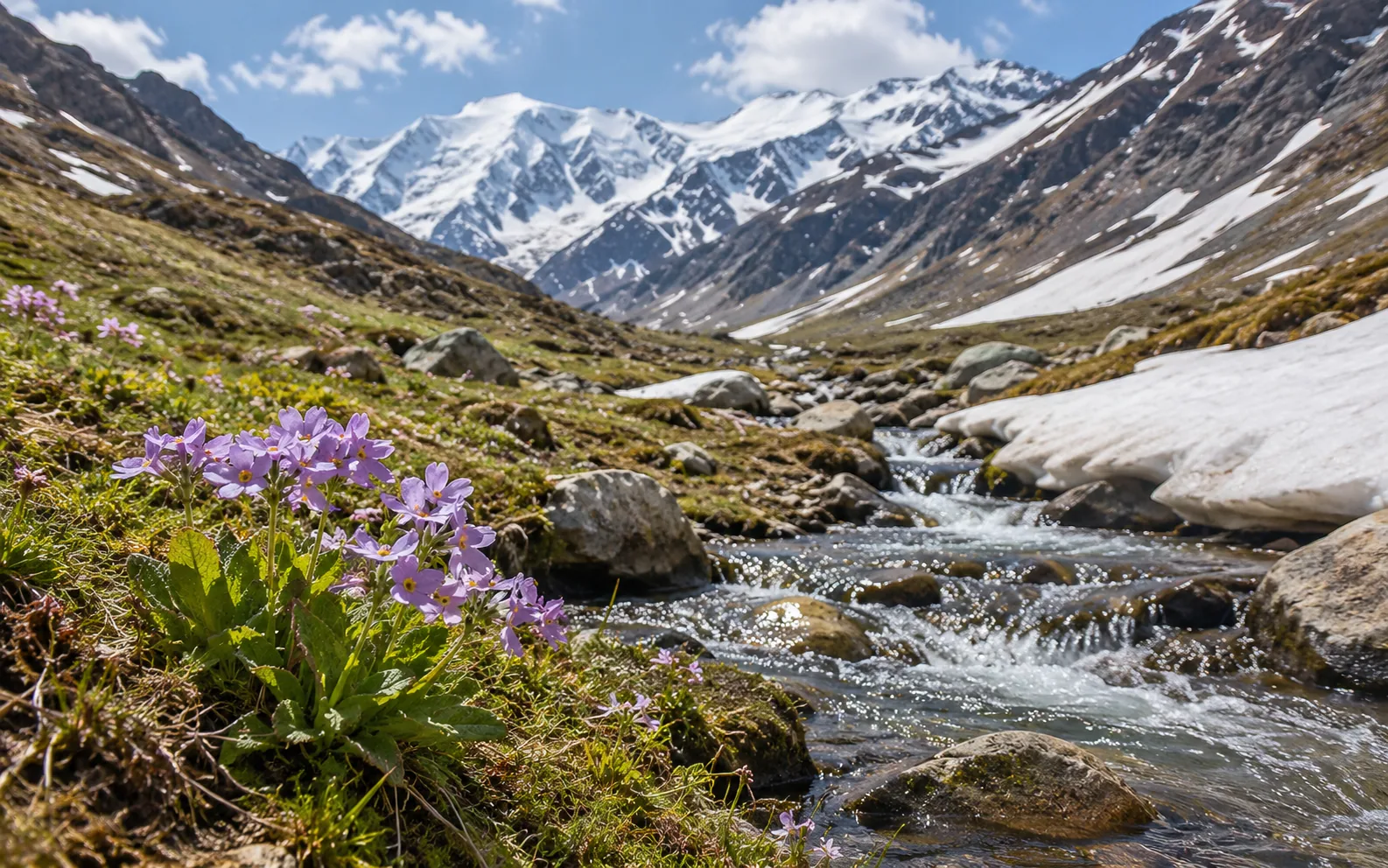
In Lahaul, spring doesn't come with rain. It comes with melting snow.
Quick answer: Lahaul snowfall feeds the meltwater its flowers depend on. The glacier snowline in the Chandra-Bhaga basin rose about 1,300 ft from 1980 to 2007, and snow cover is shrinking, but no study has yet measured a shift in Lahaul's bloom dates.
Lahaul is a cold desert: little rain falls in summer. Its fields and wildflowers live on snow and glacier melt, carried down in streams and hand-dug channels. So when the snow changes, the whole summer feels it. The glacial stream nectar.
 The snowline has moved uphill.
What the studies show
- The snowline has climbed. Satellite images of 19 glaciers in the Chandra-Bhaga basin show the end-of-summer snowline rose from about 16,400 ft in 1980 to about 17,700 ft in 2007, nearly 1,300 ft in 27 years. The authors linked it to warming and less winter snow.
- Snow cover is shrinking. Across 2001–2016, snow cover in the Chandra basin fell by about 0.12% a year.
- Some winters are very lean. Himachal's State Centre on Climate Change found snow area across four river basins, the Chenab (which includes Lahaul) among them, fell by 12.7% from winter 2022-23 to 2023-24.
What it could mean for spring
Less snow, or snow that melts earlier, could change when water reaches Lahaul's fields and meadows, and so when they flower. Elsewhere in the mountains, warming has been shown to shift flowering dates. How altitude sets bloom timing.
What no one has measured
The topic we were given says changing winters "shift Lahaul's spring awakening". That's plausible, but:
- We found no study of bloom dates in Lahaul over time.
- And no study of how Lahaul's honey season has changed.
So we report the snow, and leave the flowers as an open question.
A myth worth clearing up
"Less snow means an easier summer." Not in a cold desert. Snow is Lahaul's water supply. A thin winter can mean a dry summer.
A valley ritual
If you visit Lahaul, look up at the glaciers above the Chandra valley, then down at the channels in the fields. It's the same water, a season apart.
Common questions about Lahaul snowfall
Are Lahaul's glaciers shrinking? Studies of the Chandra-Bhaga basin show a rising snowline and some loss of glacier area since 1980.
Does snow affect honey? Indirectly. Snowmelt waters the flowers bees depend on in a valley with little summer rain.
Keep reading
- Beyond the Rohtang Pass
- The Keylong valley agriculture
- The glacial stream nectar
- The early freeze alert
- The glacial silt factor
Part of our Lahaul honey guide.
Where this comes from
- Snowline rise from 5,009 m (1980) to 5,401 m (2007) on 19 Chandra-Bhaga glaciers: Pandey, Kulkarni & Venkataraman, Geocarto International, 2013 (ICAR KRISHI record); IISc ePrints
- Chandra basin snow cover shrinking about 0.12% a year, 2001–2016: Springer
- Snow area across the Chenab, Beas, Ravi and Satluj basins down 12.72%, 2022-23 to 2023-24 (State Centre on Climate Change): Outlook Business
- Lahaul's reliance on snowmelt: see sources in The glacial stream nectar
- Heights converted from metres and rounded. No source records a change in Lahaul's bloom dates.
Raw, unfiltered honey, bottled as it is. From a valley watered by its snows.
Meet the Lahaul jar, from ₹799 for ½ kg · or see what is coming next.
Not Your Beesness, sold on āsthālaya. Delivered across India.


