
Know your honey · 3 min read
The tree line boundary: does high-altitude honey have more enzymes?
You may have read that mountain honey has 'concentrated enzymes'. Honey's enzymes come from the bees, not the altitude. What protects them is gentle handling. Here is what the science actually says.
By Akhil Verma, Co-founder, Not Your Beesness · · Updated
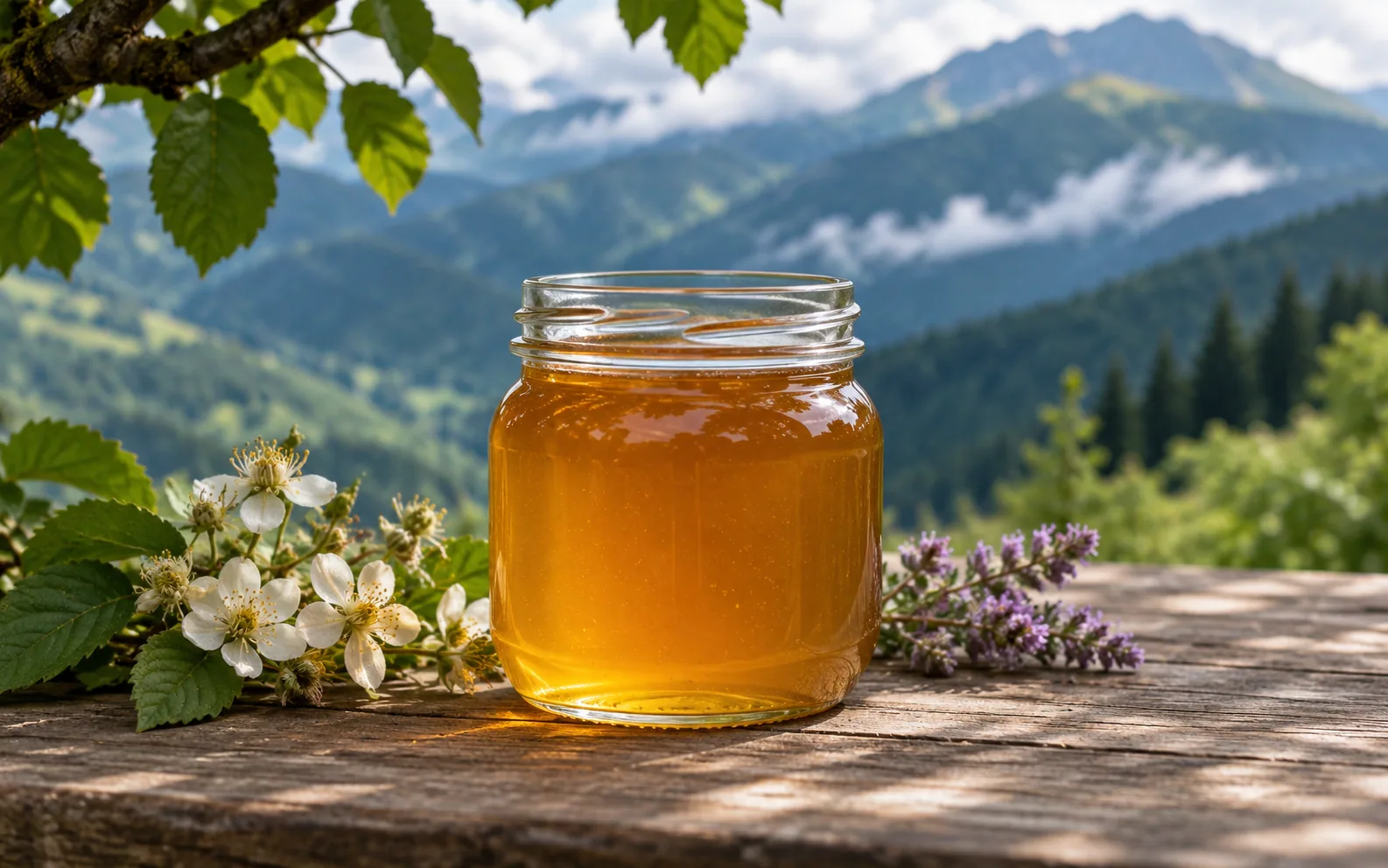
Every spoon of raw honey carries a little of the bee that made it: the enzymes it added along the way.
It is a lovely fact, and it has been stretched into a marketing claim: that honey from above the tree line has "concentrated enzyme profiles". Let's look at what is really known.
 Enzymes come from bees. Heat, not height, decides how many survive.
Where the enzymes come from
As bees turn nectar into honey, glands in their bodies add enzymes:
- Invertase splits sucrose into the simpler sugars, glucose and fructose.
- Diastase breaks down starch.
- Glucose oxidase helps make a little hydrogen peroxide, part of honey's natural defence against spoiling.
So the enzymes come from the bees, not the mountain air.
What wears them down
Enzymes are delicate. Heating honey, or storing it warm for a long time, slowly breaks them down. That is why food labs use diastase as a check: a low diastase reading can mean honey has been heated, is old, or has been mixed with sugar syrup.
What about altitude?
A study in Turkey compared honey from hives placed at different heights in the same region. The honeys were statistically different, because different plants grow at different heights. Enzyme values varied from site to site.
But the study did not show that higher honey has more enzymes. We found no good evidence for that claim. Marketing pages that say so don't cite data.
What actually matters
For enzymes, how the honey is handled matters far more than how high the hives were:
- No heating to make honey run clear
- Coarse straining rather than fine filtering under pressure
- Cool storage, out of the sun
That is how we bottle both our jars: one coarse strain, then the jar. The final Kalka press walks through it.
A myth worth clearing up
"Crystallised honey has lost its goodness." No. Setting is a natural change in the sugars, not damage. Heating it hard to melt it is what harms the enzymes. Why honey sets.
A kitchen ritual
Keep honey away from the stove and out of the sunny window. To loosen a set jar, stand it in warm (not hot) water. And add honey to drinks once they have cooled a little. Why not in boiling chai?
Common questions
Are honey enzymes good for digestion? They help the bees. Whether they do much for us is not well proven. Enjoy honey as food.
Is there a tree line in Lahaul? Trees like birch grow higher than Lahaul's valley floors. Its bare slopes are mostly dry, not too high. The 11,000-foot challenge.
Keep reading
Part of our real honey guide.
Where this comes from
- Honey at different altitudes in one region differed physicochemically; invertase 20.3–28.5 U/kg and diastase 13.2–19.1 across sites: Erdoğan & Turan, 2022, Turkish Journal of Agriculture – Food Science and Technology
- Honey enzymes added by bees' glands; diastase and invertase as markers of freshness, heating and storage: Czech Journal of Food Sciences, 2009; Mendel University paper
Raw, unfiltered honey, bottled as it is. Never heated, so the bees' work stays in.
Meet the Lahaul jar, from ₹799 for ½ kg · or see what is coming next.
Not Your Beesness, sold on āsthālaya. Delivered across India.


