
Know your honey · 6 min read
The warm brush bloom: the Shivalik shrubs bees love
The scrubby slopes around Kalka look plain from the road. Up close, they are a year-round flower garden. Meet six shrubs that keep the foothills in bloom, and what each one gives the bees.
By Akhil Verma, Co-founder, Not Your Beesness · · Updated
The best flower garden near Kalka has no gardener, no fence and no name. It is the scrub.
Drive up from Chandigarh and the low hills look dry and tangled: thorny bushes, dusty leaves, nothing much to see. Walk into that scrub on a sunny morning and it hums. These warm, sheltered slopes flower in waves, almost all year round, and the bees know every bush.
Here are six shrubs worth knowing. You probably know a few of them from your own kitchen already.
 Six shrubs, six seasons. Between them, the scrub is rarely without a flower.
Binda: the winter flower
Flowers: December to April.
When almost everything else has stopped, binda (squirrel tail) carries fuzzy white flower spikes right through the cold months. It belongs to the mint family, along with tulsi and pudina, and grows on dry, open slopes from Punjab across the Himalayan foothills.
Look for: soft, furry white spikes on a grey-green bush, in the middle of winter.
Basuti: the cough-kadha bush
Flowers: February to April.
You may know basuti (adusa) from the bitter kadha some families boil for a winter cough. In the scrub, it is a low bush with soft leaves and white, lipped flowers, and it is a documented nectar source for honeybees.
Look for: white flowers with a "lip", like a tiny open mouth, on a bush with large soft leaves.
Dhawai: the red one
Flowers: January to May, most in March and April.
Dhawai (dhaya) is the easiest to spot: arching stems lined with rows of small, bright red tubular flowers. Its flowers have long been used in traditional Ayurvedic preparations. Its pollen also turns up in Indian forest honeys, a sign that bees go back to it again and again.
Look for: a shrub that looks as if someone threaded tiny red chillies along every branch.
Karonda: the achaar shrub
Flowers: February to April.
Karonda is a thorny bush with starry white flowers in spring. In the monsoon it gives the small, sour berries that end up in karonda ka achaar in kitchens across North India. A study in Hisar found the small dwarf honeybee among the most frequent visitors to its flowers.
Look for: sharp, paired thorns, glossy leaves and small white star-shaped flowers.
Kadi patta: the tadka plant
Flowers: March to June.
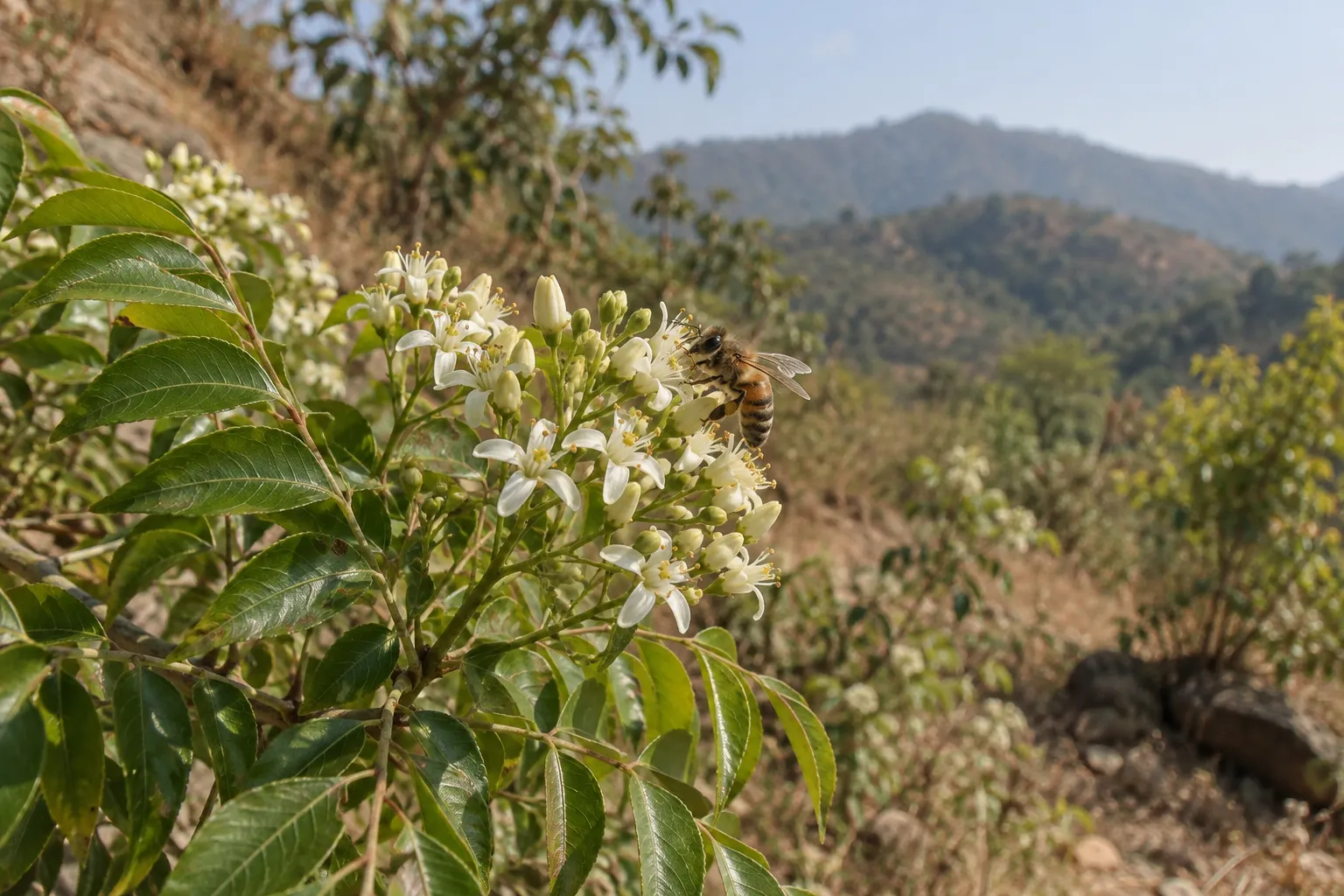
The kadi patta in your tadka grows wild in these foothills, often in the shade under bigger trees. In spring it carries clusters of tiny, fragrant white flowers. Crush a leaf as you walk past, and you will know it at once.
Look for: the smell. Then the small white flower clusters at the tips.
Ber: the autumn feast
Flowers: around August to October.
As the monsoon fades, the ber bushes and trees cover themselves in tiny green-yellow flowers. They are easy to miss, but beekeepers do not miss them: ber is listed among the main bee plants of the region. The fruit follows in late winter, and many families offer it at Maha Shivratri.
Look for: thorny branches with small, round, shiny leaves, and a faint buzz in September.
A word about lantana
You will see bright pink-and-yellow lantana everywhere in the Shivaliks. It is pretty, but it is an invader from the Americas that crowds out native shrubs like the six above. The native scrub is what keeps these hills, and their bees, so rich.
What the scrub means for your jar
It is why the foothills are generous. Look at the flowering strips in the picture: binda covers winter, basuti, dhawai and karonda carry spring, kadi patta runs into summer, and ber picks up after the monsoon. Between them, the scrub is rarely without a flower. That is the long, warm season that sets Kalka apart from the high valleys.
It is why every batch is different. Our Kalka jar is multiflora: the bees take whatever is in bloom. A batch made while dhawai and basuti were flowering will not taste quite like one made in the ber season. That is the point of raw honey.
One gentle myth to clear up: a honey does not carry the medicine of the plants the bees visited. Basuti's place in the cough kadha belongs to its leaves, boiled by your daadi, not to the honey. We sell honey as honey, not as medicine.
A daadi ka nuskha from the scrub
The scrub and the kitchen meet every winter:
- Adrak and honey. A little fresh ginger juice with a spoon of honey, taken slowly for a scratchy throat.
- Honey after the kadha. Many families let a bitter kadha cool to warm, then stir in a spoon of honey to make it easier to drink. Warm, never boiling. (Here is why.)
Both are tradition, not medicine. And honey is not for babies under one.
Common questions
Can I walk into the scrub to see these shrubs? Yes, on public trails and roadsides. Watch out for thorns (karonda and ber have plenty), and give working hives a wide berth. Bees are calm when left alone.
Which of these shrubs is in my Kalka jar? We can't say for any single batch. Multiflora honey is a blend of whatever was blooming, and the mix changes with the weeks. That is why no two batches are quite alike.
When is the scrub at its best? February to April, when basuti, dhawai and karonda overlap with the spring bloom of the bigger trees.
Keep reading
Part of our Kalka honey guide.
Where this comes from
- Binda (Colebrookea oppositifolia), flowering December to April at 250–1,700 m: Flowers of India; XTBG
- Basuti, flowering February to April: KIRAN, Government of India. Basuti as a nectar source: IISc ENVIS report
- Dhawai (Woodfordia fruticosa), flowering January to May, mainly March and April: Great Himalayan National Park; Wikipedia. Its pollen in Indian honeys: Geophytology, 1994
- Karonda flower visitors in Hisar: Indian Journal of Agricultural Sciences
- Curry leaf, flowering March to June: ICIMOD
- Ber among the main bee plants: Status and prospects of migratory beekeeping in Punjab. Ber flowering depends on climate: Agricultural Reviews
- Flowering months in the illustration are indicative and shift with each winter.
Raw, unfiltered honey, bottled as it is. Made from whatever the warm foothill scrub had in bloom.
Find your Kalka jar, from ₹499 for ½ kg · or give both places in one box: the Diwali gift box.
Not Your Beesness, sold on āsthālaya. Delivered across India.


