
Know your honey · 4 min read
The wild berry brush: ber, jharberi and the jujube family bees seek out
The thorny ber bushes of the Kalka scrub belong to a famous family. Their cousin in Arabia makes one of the world's most prized honeys. Here is what the jujubes give bees, and what we can and cannot say about their taste.
By Akhil Verma, Co-founder, Not Your Beesness · · Updated
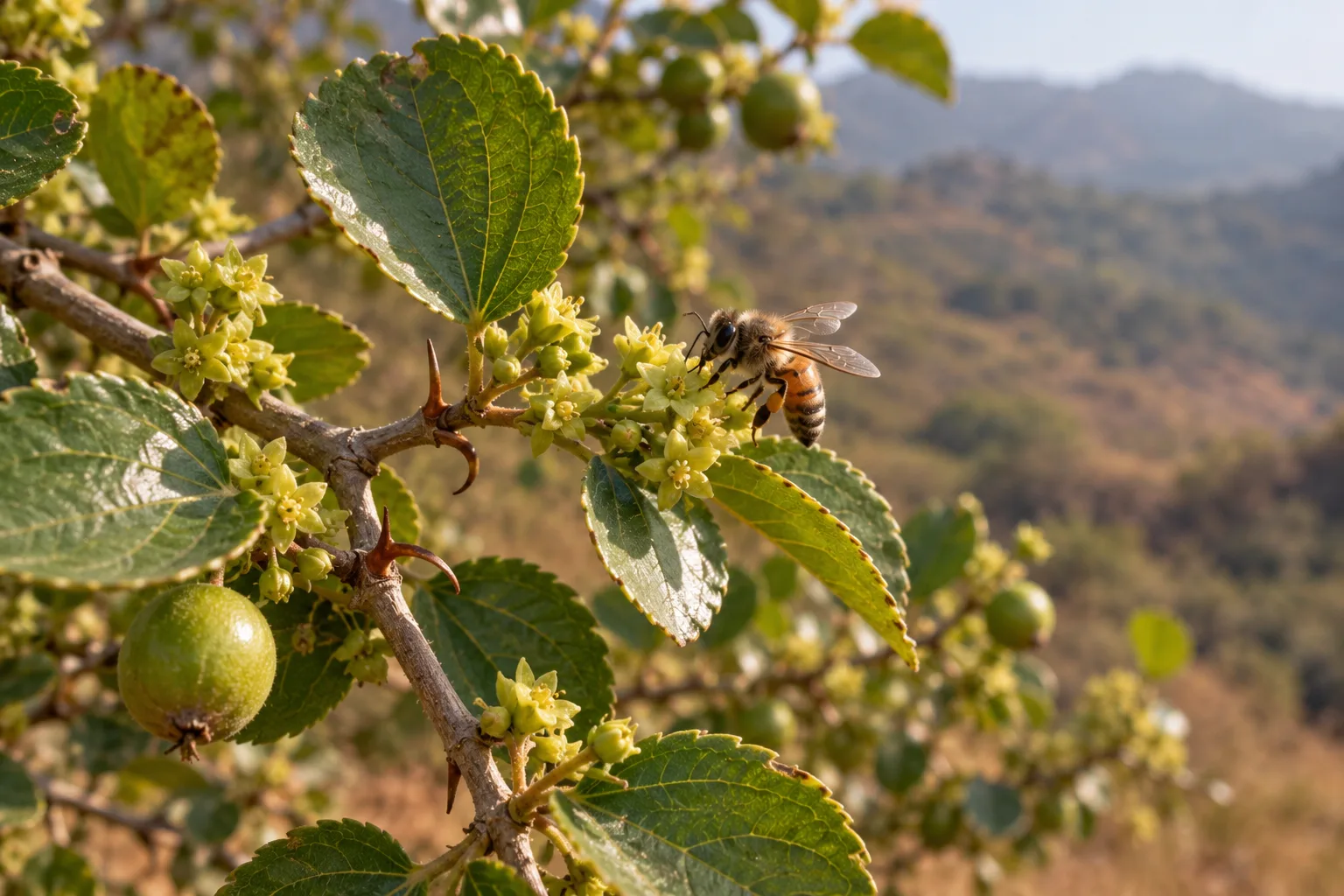
Every child in North India knows the ber: the small, sour-sweet fruit you pick off a thorny bush, and the scratches that come with it.
What fewer people know is that the ber belongs to one of the most important honey families in the world. Its cousin in Arabia, the sidr, makes a honey so prized that it sells for many times the price of ordinary honey.
Around Kalka, the jujube family turns up in two forms: the ber tree, and the low, tangled jharberi bush.
 Three jujubes, one thorny family. Bees work all of them where they grow.
Ber: the Kalka tree
Ber is a small tree or large bush with round, shiny leaves and orange-red fruit. As the monsoon fades, it covers itself in tiny green-yellow flowers, easy to miss but busy with insects. It is listed among the main bee plants of the region, and it carries the bees into autumn after the lean monsoon weeks. More on the autumn turn.
Jharberi: the wild brush
Jharberi is the ber's scrappier cousin: a low, thorny, tangled bush with small leaves and little red berries, common on dry scrub and field edges across North India. It is the "wild berry brush" of this post's title.
Studies of jharberi abroad find honeybees working its flowers for both nectar and pollen, with foraging low in the early morning and busiest in the warm afternoon.
Sidr: the famous cousin
In Yemen, Saudi Arabia and North Africa, the jujube family gives sidr honey, one of the most sought-after honeys in the world. Studies of jujube honeys in North Africa describe them as amber yellow to light brown.
Sidr does not grow around Kalka. It is in this post for family resemblance, and as a warning (see below).
What about the "earthy tang"?
You may read that ber honey has a tangy, earthy taste. Some Indian sellers describe it as sweet and tangy. But we have not found any proper study of the taste of ber honey from India, so we would rather not promise a flavour we cannot back up.
What we can say: our Kalka jar is multiflora. When the ber is in bloom, it can be part of what the bees bring home, alongside the scrub shrubs and whatever else is flowering. The taste of any batch follows its weeks. Taste honey like a beekeeper.
A myth worth knowing
"Sidr honey from a local shop is the real Arabian thing." Be careful. Because sidr is so valuable, it is a target for mislabelling. A jar sold as "sidr" in India may be honey from a local jujube, or not jujube at all. Look for a clear source and a seller who can tell you where it came from. What labels must say.
Ber in the Indian home
- Ber at Maha Shivratri, offered at temples across North India.
- Ber ka achaar and chooran, the sour-salty treats of a winter afternoon.
- And for the honey jar: adrak aur shahad, a little fresh ginger juice with a spoon of honey for a winter throat. Tradition, not medicine, and stirred in warm, never boiling. (Here is why.) Honey is not for babies under one.
Common questions
When does ber flower around Kalka? Mostly as the monsoon fades, from around August to October. The weather shifts it each year.
Do you sell ber honey? Not as a separate jar. Our Kalka honey is multiflora, so ber can be one of many flowers in it.
Keep reading
Part of our Kalka honey guide.
Where this comes from
- Ber among the main bee plants of the region: Status and prospects of migratory beekeeping in Punjab
- Honeybees foraging on jharberi (Ziziphus nummularia), with an afternoon peak: Saudi Digital Library; Springer
- Jujube honey colour, amber yellow to light brown (Algeria): FAO AGRIS
- Sidr honey studies: Journal of Plant Protection and Pathology
- Ber honey described as sweet and tangy: seller listing
Raw, unfiltered honey, bottled as it is. From the thorny, generous scrub of the foothills.
Find your Kalka jar, from ₹499 for ½ kg · or see what is coming next.
Not Your Beesness, sold on āsthālaya. Delivered across India.


