
Know your honey · 4 min read
The Shivalik sunrise: how morning light and the bees' inner clock start the day
Sunrise over the Shivaliks is the starting gun for the foothill hives. But the bees are not caught by surprise. They have been expecting the morning, because they keep a clock of their own.
By Akhil Verma, Co-founder, Not Your Beesness · · Updated
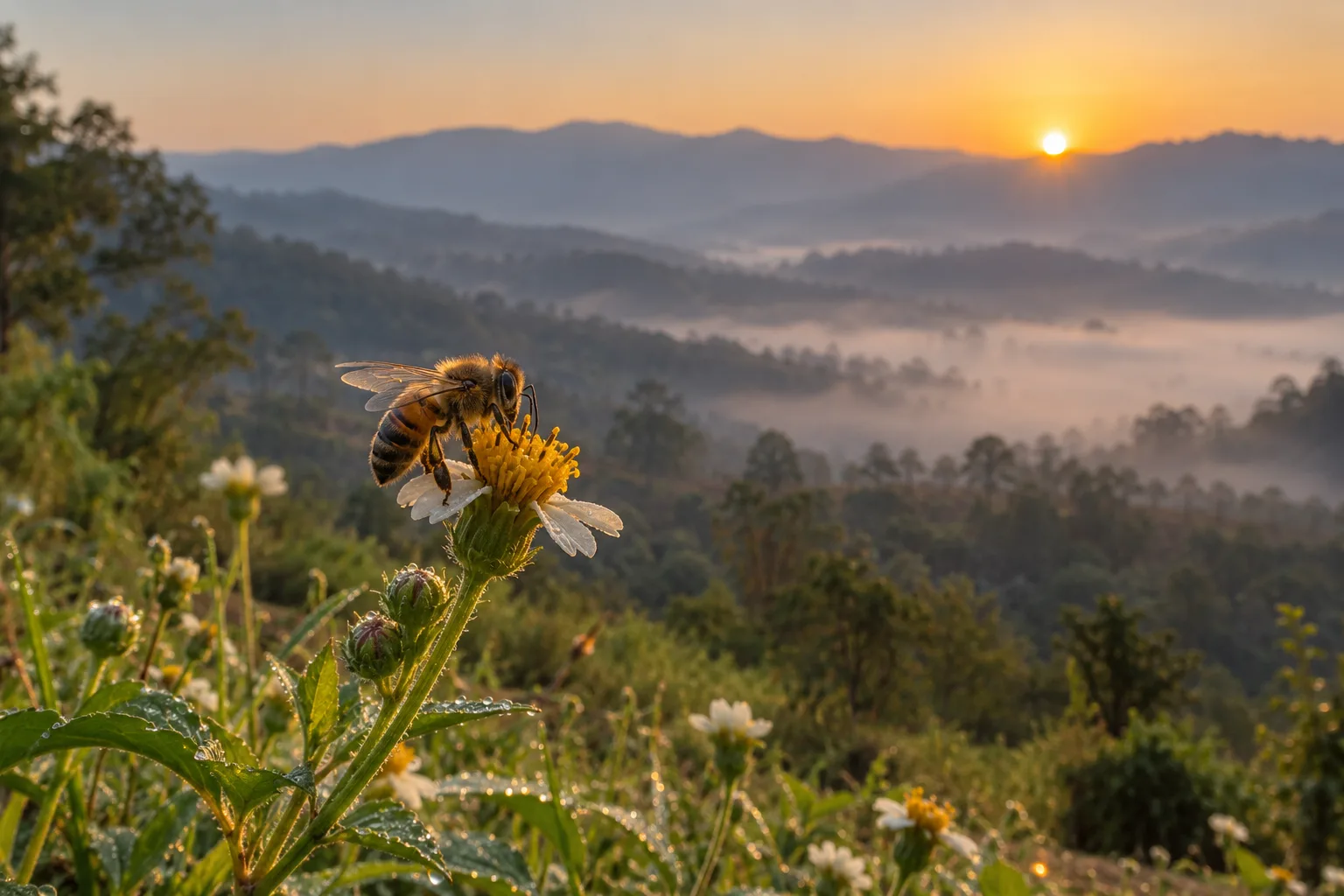
On a spring morning in the foothills, the first sun touches the ridges, then slides down the slopes. Within the hour, the hives are humming.
It looks as if the sunrise wakes the bees. The real story is more remarkable: the bees were already expecting it.
 Light and warmth let the foragers fly. Their inner clock tells them when.
Light and warmth: the green light
Foragers need two things before they can work:
- Light, to see and to navigate by the sun.
- Warmth. Honeybees rarely fly below about 12 to 13°C, and do their best work around 22 to 25°C. What decides a bee's working day.
On a cold or misty morning, the bees wait. As the sun warms the air, the first scouts go out, then the foragers follow.
The bees' inner clock
Here is the remarkable part. Honeybees carry an internal, roughly 24-hour clock, and they use it to plan.
The jet-lag test. In a famous experiment, bees trained to feed at a set time in New York were flown overnight to California. On their first day, they kept foraging on New York time, not local sun time. Their clock was inside them.
Nine appointments a day. Foragers can learn to turn up at a feeding place at a given time, and studies have shown they can learn up to nine different times of day.
On time for flowers. Many flowers open their nectar at particular times. Researchers say the bees' clock tells them when to arrive as a flower opens, and when to rest because the food is "closed".
Light, warmth or clock?
All three work together. Researchers note it is not always easy to separate the bees' inner clock from the daily cycles of light and temperature that keep it set. What is clear is that bees do not just react to the morning. They plan for it.
What it means for your jar
A forager that arrives right as a flower opens gets the best of its nectar. Multiply that by thousands of bees and hundreds of mornings, and you have a Kalka jar of foothill honey.
A myth worth clearing up
"Bees are up at dawn." Not always. They are up when it is light and warm enough. On a cold dawn they wait, and on a warm one they may already be expected at the flowers.
A sunrise ritual
Start the day the way the bees do, in the sun: a cup of warm water with nimbu and a spoon of honey, stirred in once it has cooled to sipping heat. Tradition, not medicine. Honey is not for babies under one.
Common questions
Do bees fly at night? Honeybees are daytime fliers. Night flowers belong to the moths. The night-blooming jasmine.
Do bees sleep? Yes. Foragers rest at night, often in the outer parts of the hive.
Keep reading
Part of our guide to how bees make honey.
Where this comes from
- The jet-lag experiment (New York to California): KTVQ, A Wilder View
- Bees' clock and anticipation of flower rewards: Bloch et al., Time is honey, Hebrew University; PubMed Central
- Learning up to nine times a day: Pherobase literature record
- The clock tells foragers when to arrive and when to rest: University of Würzburg via idw
- Minimum and best flight temperatures: University of Maine Extension
Raw, unfiltered honey, bottled as it is. Gathered one foothill morning at a time.
Find your Kalka jar, from ₹499 for ½ kg · or see what is coming next.
Not Your Beesness, sold on āsthālaya. Delivered across India.


