
Know your honey · 3 min read
The wild sage clumps: meet Artemisia, the silvery shrub of Lahaul's slopes
The silvery, sharp-smelling bushes on Lahaul's dry slopes are often called wild sage. Most are Artemisia, a wind-pollinated shrub of the daisy family. True sage is a different plant, and neither leaves a proven 'herbal marker' in honey.
By Akhil Verma, Co-founder, Not Your Beesness ·
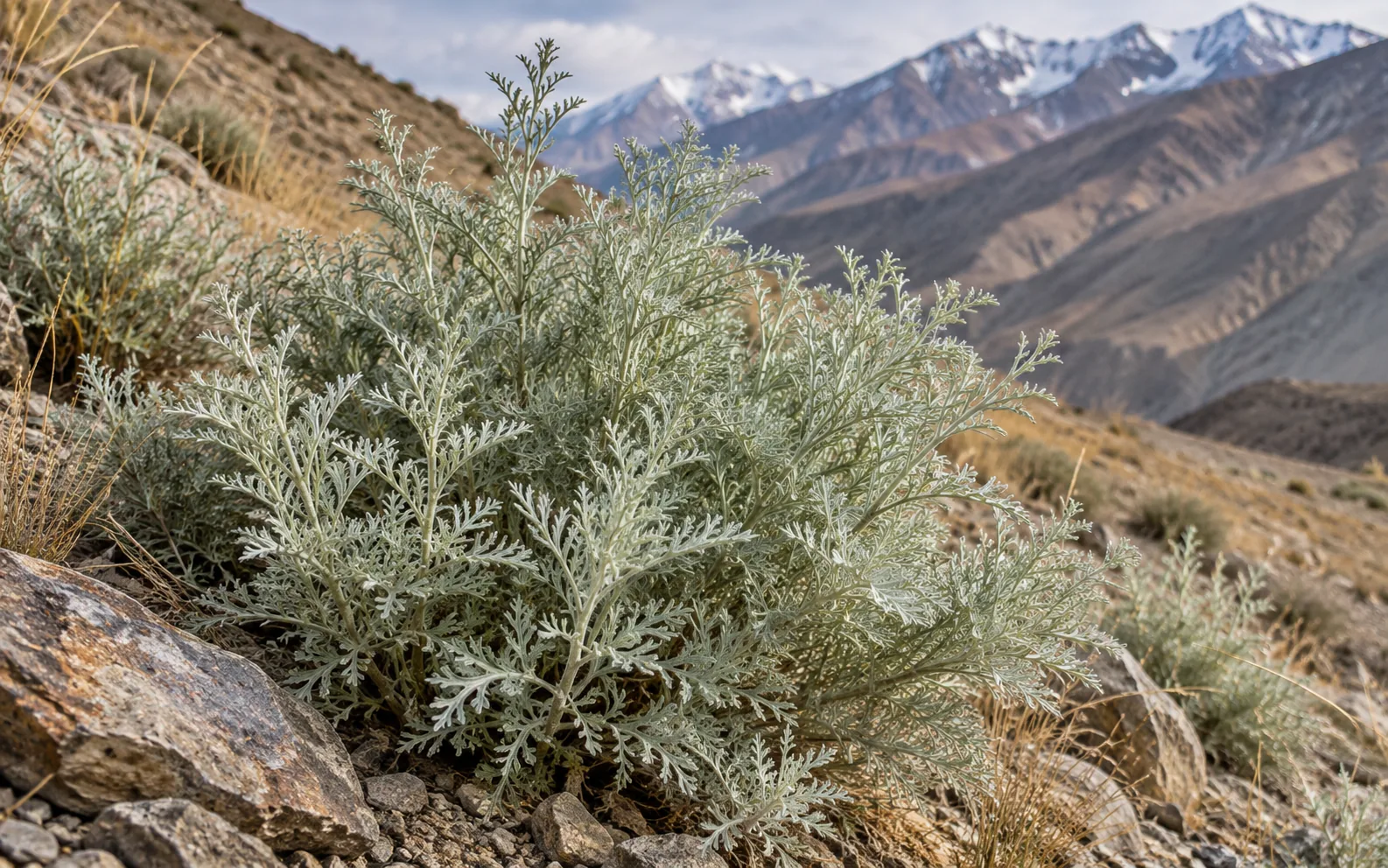
Walk a dry slope in Lahaul and crush a grey-green leaf. The sharp, bitter smell is unmistakable. Many people call it wild sage. Botanists call it Artemisia.
Quick answer: Lahaul's 'wild sage' is usually Artemisia, one of the main shrubs of the cold desert. It's wind-pollinated and gives bees little or no nectar; true sage (Salvia) is a different, mint-family plant.
The silvery shrubs that dot Lahaul's stony slopes are among the toughest plants of the cold desert. They're often called "sage" for their smell. But they're not true sage, and the difference matters if you're wondering what they give bees.
 The 'sage' on the slopes is usually sagebrush.
Artemisia: the cold desert's shrub
Artemisia brevifolia is one of the predominant shrubs of the cold-desert Himalaya, especially in Ladakh and Lahaul. It grows on dry, stony slopes and open ground from about 6,900 to 15,700 feet.
Artemisia belongs to the daisy family. Some species are called "sagebrush", which is where the confusion with sage comes from.
Why it gives bees little
Artemisia's flowers are tiny and dull, and they're wind-pollinated: they shed light pollen on the breeze rather than offering nectar to insects. Wind-pollinated plants usually give bees little or no nectar. Bees may gather some pollen, but Artemisia is not a nectar plant.
True sage is different
True sage, Salvia, belongs to the mint family. Its flowers are lipped and colourful, built to be visited by insects, and many sages are excellent nectar plants. But the silvery shrub on Lahaul's slopes isn't one of them.
What we can't claim
The topic we were given asks about "aromatic herbal markers" of sage in Lahaul honey. We can't make that claim:
- Lahaul's "wild sage" is mostly wind-pollinated Artemisia, which gives little nectar.
- No study has looked for sage or Artemisia markers in Lahaul honey.
A myth worth clearing up
"Plants that smell strong make strong-tasting honey." Not necessarily. A plant's smell often lives in its leaves, which bees don't use. What matters is its nectar, and many aromatic shrubs make little or none.
A hillside ritual
On a Lahaul walk, rub a leaf of Artemisia and a sprig of wild thyme between your fingers, one after the other. Two strong scents, two very different plants. Only one of them is busy with bees. The wild thyme patches.
Common questions about Artemisia and wild sage
Is Artemisia the same as wormwood? Wormwood is one kind of Artemisia. The genus includes many species, from wormwood to tarragon.
Is Artemisia pollen an allergy problem? In many parts of the world, wind-blown Artemisia pollen is a known seasonal allergen.
Keep reading
Part of our Lahaul honey guide.
Where this comes from
- Artemisia brevifolia among the predominant cold-desert species of Ladakh and Lahaul, at 2,100–4,800 m on dry stony slopes: Himalayan Voices, Artemisia brevifolia
- Artemisia flowers wind-pollinated; daisy family; some species called sages, confused with Salvia: Wikipedia, Artemisia
- No source looks for sage or Artemisia markers in Lahaul honey. Heights converted from metres and rounded.
Raw, unfiltered honey, bottled as it is. From the flowers of a cold desert.
Meet the Lahaul jar, from ₹799 for ½ kg · or see what is coming next.
Not Your Beesness, sold on āsthālaya. Delivered across India.


