
Know your honey · 3 min read
The Pangi border margins: where the Chenab leaves Lahaul for the forests of Chamba
Follow the Chenab downstream out of Lahaul and you enter Pangi, a remote valley of Chamba district. It's lower, greener and forested, with belts of deodar, pine, fir and birch climbing to alpine meadows.
By Akhil Verma, Co-founder, Not Your Beesness ·
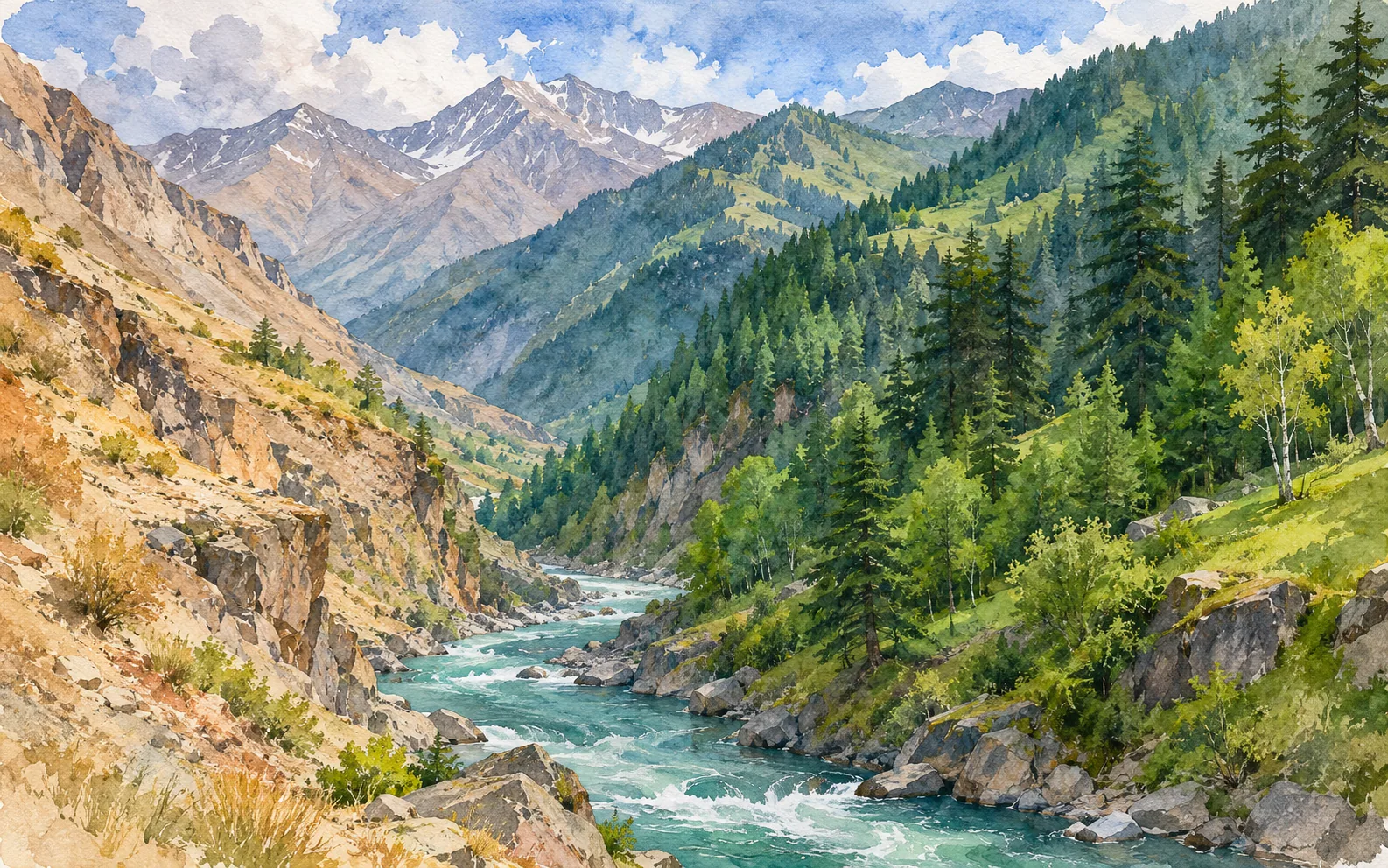
Leave Lahaul by following the Chenab downstream, and the bare brown slopes slowly turn green. You've crossed into Pangi.
Quick answer: The Pangi valley lies in Chamba district just west of Lahaul, where the Chenab flows for about 50 miles. Lower and wetter than Lahaul, it holds deodar, blue pine, fir and birch forests below alpine meadows.
Pangi is a remote valley of Chamba district, just west of Lahaul. The Chandrabhaga, now the Chenab, flows through it for about 50 miles. It's lower and wetter than Lahaul, and its slopes carry real forests.
 From deodar forest to alpine meadow.
A valley of forests
Pangi runs from about 6,600 feet at its lowest to peaks of over 19,700 feet in the Zanskar range. As you climb, the forest changes:
- Deodar forest in the lower valley, with walnut, hazel, willow and poplar in damp hollows.
- Blue pine and fir higher up.
- Birch on north-facing slopes, up to about 12,500 feet.
- Willow scrub to about 13,100 feet.
- Alpine meadows above the tree line.
How it compares with Lahaul
Lahaul, just upstream, is a cold desert: mostly treeless, its green tied to irrigation. The blue pine margins. Pangi, lower and wetter, holds the forests Lahaul lacks. Two valleys, one river, very different landscapes for bees.
Cut off by snow
Pangi is one of the most remote corners of Himachal. It's best reached from about April to July, over high passes such as Sach Pass. From around mid-October, snow cuts the valley off, and in winter the only quick way in is by emergency helicopter.
What we can't claim
The topic we were given talks about "sourcing honey where Lahaul meets the wild Chamba ranges". We don't claim our honey comes from Pangi or from the Lahaul–Pangi border. Our Lahaul jar is a Lahaul honey. Pangi is here because it shows how much the land changes along a single river.
A myth worth clearing up
"Forest honey is always better than valley honey." No. Forests offer some flowers and sometimes honeydew; open valleys and meadows offer others. Neither is better by default. Forest edge vs deep woods.
A traveller's ritual
If you drive from Lahaul into Pangi, watch for the first deodar. It marks the point where the cold desert gives way to the forested hills.
Common questions about the Pangi valley
Is Pangi part of Lahaul? No. Pangi is in Chamba district. It borders Lahaul and Spiti district.
Which river flows through Pangi? The Chandrabhaga, the river that becomes the Chenab, about 50 miles of it.
Keep reading
- The Gondhla castle corridor
- The Miyar valley excursion
- The Chenab river origins
- The Pinjore border flora
Part of our Lahaul honey guide.
Where this comes from
- Pangi in Chamba district, bordering Lahaul and Spiti; about 2,000 m to over 6,000 m; Chandrabhaga about 85 km through the valley; deodar, blue pine and fir, broadleaved trees in damp hollows; birch to about 3,800 m; willow scrub to about 4,000 m; access April–July, cut off from mid-October: Wikipedia, Pangi Valley
- Sach Pass route into Pangi: Outlook Traveller
- Heights converted from metres and rounded. Belts are approximate.
Raw, unfiltered honey, bottled as it is. From one river's high valley.
Meet the Lahaul jar, from ₹799 for ½ kg · or see what is coming next.
Not Your Beesness, sold on āsthālaya. Delivered across India.


