
Know your honey · 3 min read
The dense undergrowth: why the bees' riches are at the forest edge
It is romantic to imagine secret nectar hidden deep in the woods. But dense, shady forest hides few flowers. For bees, the real treasure is at the sunny edges and in the clearings.
By Akhil Verma, Co-founder, Not Your Beesness · · Updated
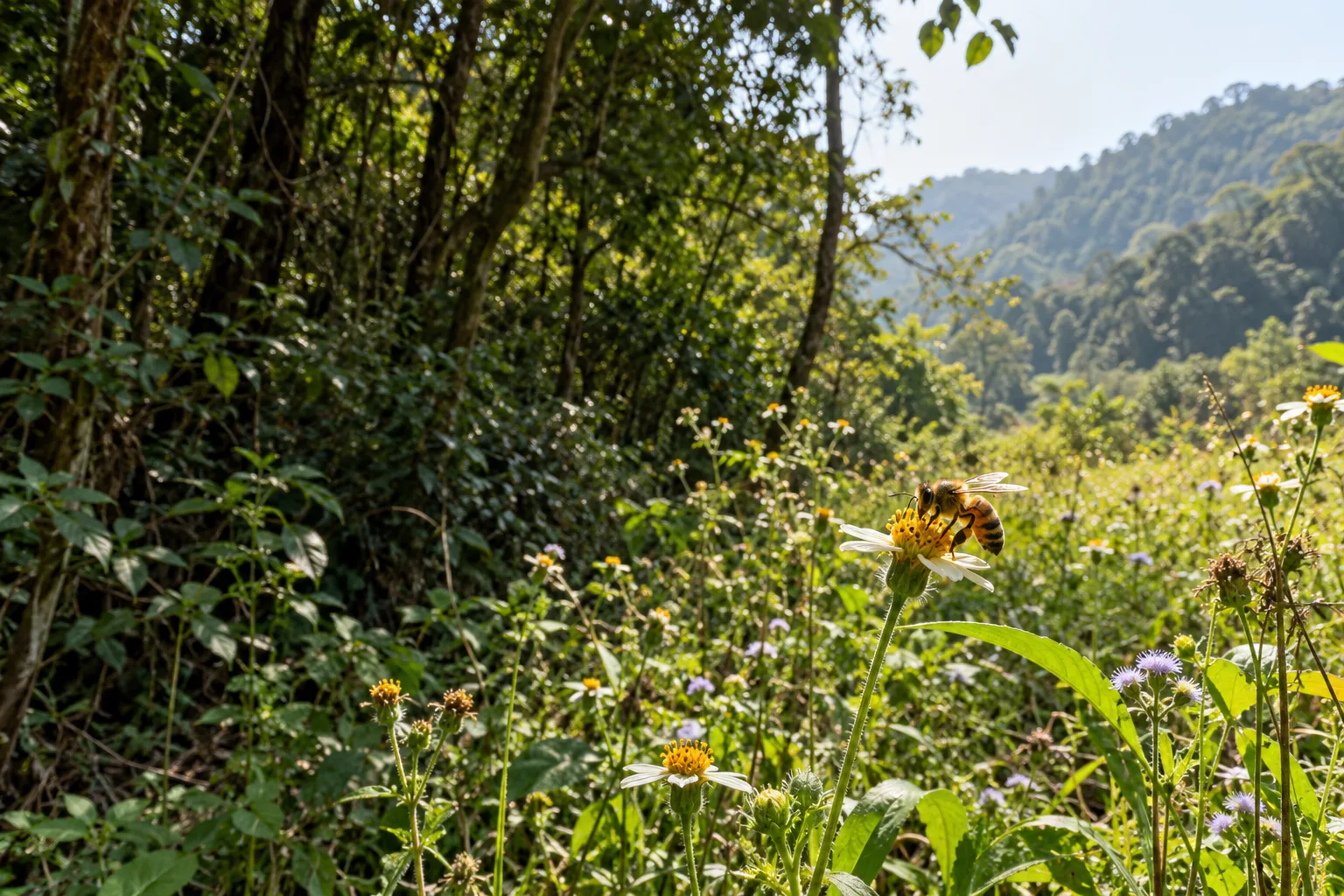
Step into a dense patch of Shivalik forest in May and the light drops away. It is cool, quiet and green, and there are hardly any flowers.
Flowers need light. In the deep shade of a closed canopy, few plants can afford to bloom. The real flower show is where the light gets in: edges, clearings and paths.
 Deep shade hides few flowers. The sunny edges are where the bees are.
What the studies say
A study of second-growth forests, published in Nature Ecology & Evolution, found that dense forest interiors held few flowering plants, while light-filled gaps were full of them. At the edges, it found about ten times more pollinators, and more kinds of them, than in the dense interiors.
A study in the US state of Georgia also found more bees at forest edges than inside, and work in France found bees thinning out with distance from a forest edge.
To be fair, not every study agrees: a UK woodland study found many bees just as common inside as at the sunny edges. Forests differ.
The foothill version
Around Kalka, the edges are everywhere: where scrub meets field, where orchards meet forest, along roads, streams and footpaths. That patchwork is exactly what bees like.
- Scrub edges: basuti, karonda, dhawai and binda. The warm brush bloom.
- Riverbanks: shisham along the seasonal streams. The riverbed flora.
- Footpaths and field margins: the humble weeds. The footpath blossoms.
So, hidden flavours of the deep woods?
We'd love to promise them, but the evidence points the other way. Deep shade means few flowers, and few flowers mean little nectar. The character of our Kalka jar comes from the sunny, mixed edges of the foothills.
A myth worth clearing up
"Wild forest honey comes from deep in the forest." Partly. Wild hives do hang high in forest trees, but their bees forage wherever flowers are, often at edges and in clearings. Our wild forest honey is on our list.
A forest-walk ritual
On your next walk, watch the edge where trees meet open ground. That's where you'll see the bees. Bring a small jar of honey for the picnic: it needs no fridge. Honey is not for babies under one.
Common questions
Do bees ever forage in the forest? Yes, on trees that flower in the canopy, like jamun and semal, and in clearings. Dense, shady undergrowth is what offers little.
Is cutting forest good for bees, then? No. Healthy forests with natural gaps and edges, not cleared land, support the most life.
Keep reading
Part of our Kalka honey guide.
Where this comes from
- Dense secondary-forest interiors low in flowers; about ten times higher pollinator abundance at edges: University of Western Australia summary of the Nature Ecology & Evolution study
- More bees at forest edges than interiors (Athens, Georgia): PubMed Central; bees decline with distance from forest edge (France): Frontiers in Ecology and Evolution
- Bees as common in woodland understories as at edges (UK): Earth.com
- The bar comparison in the illustration is relative, from one study.
Raw, unfiltered honey, bottled as it is. From the sunny edges of the foothills.
Find your Kalka jar, from ₹499 for ½ kg · or see what is coming next.
Not Your Beesness, sold on āsthālaya. Delivered across India.


