
Know your honey · 3 min read
The bamboo grove margins: do shaded hollows change the character of foothill honey?
Bamboo groves feel like the heart of the foothills: cool, rustling and shaded. But bamboo is mostly wind-pollinated, flowers once in decades, and offers bees little nectar. Here is the honest picture.
By Akhil Verma, Co-founder, Not Your Beesness · · Updated
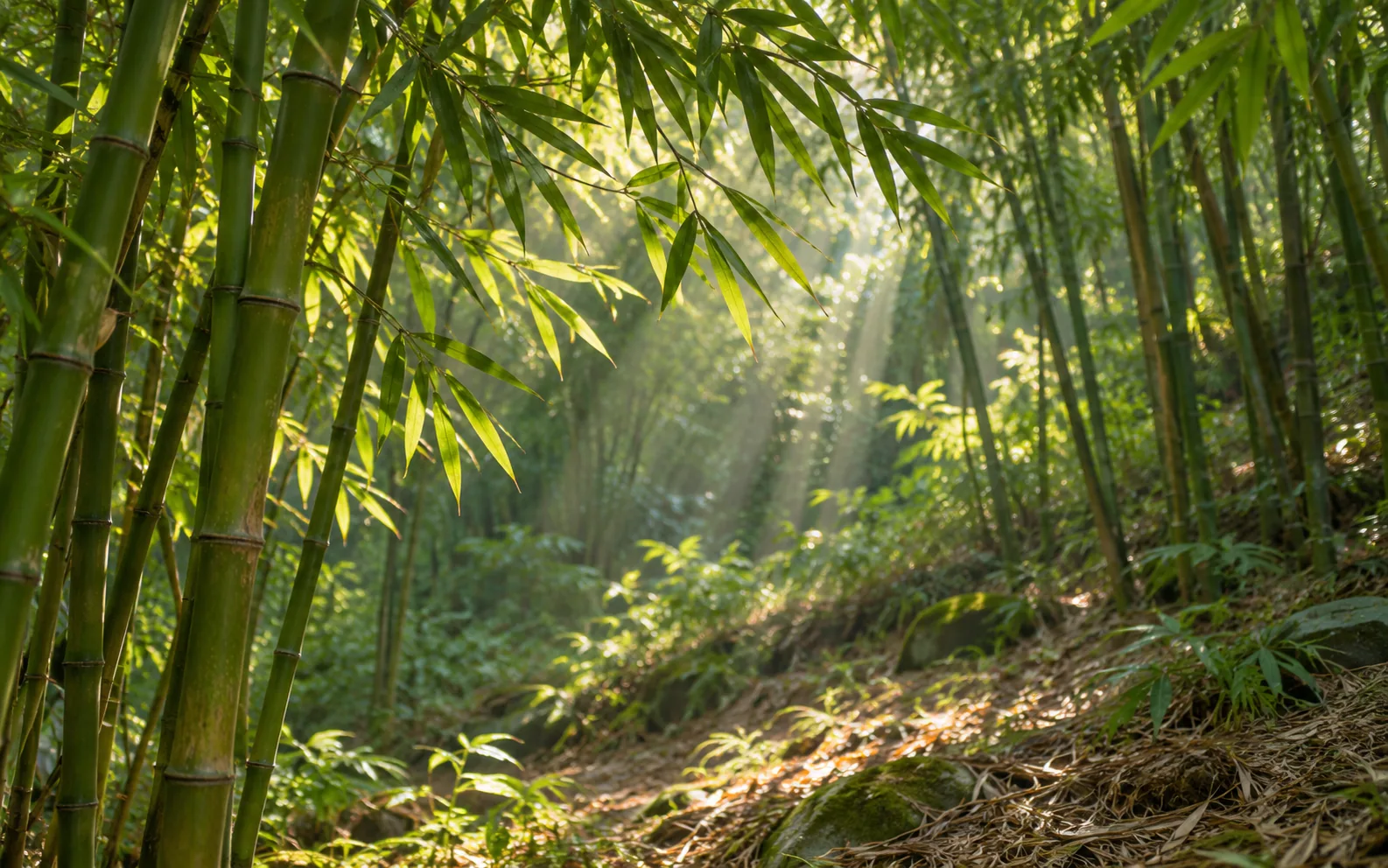
Stand in a bamboo grove on a windy day and you hear it before you see it: a soft, constant creaking. It is one of the loveliest sounds in the foothills. It is not, mostly, a sound of bees.
Bamboo is a grass, and like most grasses it is wind-pollinated. It sheds pollen on the breeze and offers little or no nectar. So the romantic idea that shaded bamboo hollows give a special character to honey runs into a problem: there is very little in them for bees to make honey from.
 Some bamboos flower every few years, some once in a century.
Bamboo hardly ever flowers
Many bamboos spend decades growing without flowering at all. Then, often, a whole stand flowers at once, sets seed, and dies back.
- Some species flower every few years.
- Many go decades between flowerings.
- Japanese timber bamboo, Phyllostachys bambusoides, has been recorded at around 130 years.
So in most years, a bamboo grove has no flowers for bees at all.
Do bees ever use bamboo?
Sometimes. When bamboo does flower, honeybees can visit it for pollen:
- In Yunnan, China, the Asian hive bee Apis cerana has been recorded collecting bamboo pollen.
- In Mexico, honeybees visited flowering Guadua bamboo.
- Some studies suggest honeybees can help pollinate certain bamboos.
That is pollen, the bees' protein food, rather than nectar, the stuff of honey. We found no evidence that bamboo shapes the taste of a honey.
What about shade?
Shaded hollows are cool and pleasant, but shade means fewer flowers. Bees find most of their food where the light gets in: edges, clearings and paths. The dense undergrowth post goes into why. We found no study showing that shaded hollows change a honey's character.
What bamboo groves do offer is shelter: from wind and from the harsh afternoon sun. Wind keeps bees at home, so a sheltered edge can be a good place for bees to work from.
A myth worth clearing up
"Bamboo honey is a special kind of honey." Be careful. Bamboo flowering is rare and gives little or no nectar. A product sold as "bamboo honey" is often something else, such as honey stored in bamboo or a flavoured syrup. Ask what it really is.
A grove ritual
Next time you walk past a bamboo grove, stop and listen to it creak in the wind. Then look at the sunny edge beside it. That's where you'll find the flowers, and the bees.
Common questions
Does bamboo flowering help bees when it happens? It can give a burst of pollen. But mass flowering is rare and unpredictable, so no beekeeper can plan around it.
Is there bamboo in your Kalka honey? We don't know, and we don't claim it. Only pollen analysis could show it, and in most years there is no bamboo flowering to find.
Keep reading
Part of our Kalka honey guide.
Where this comes from
- Bamboo flowering intervals and mass flowering: Wikipedia, Bamboo blossom; NC State Extension, The curious case of flowering bamboo
- Apis cerana collecting bamboo pollen in Yunnan: PubMed Central
- Honeybees visiting flowering Guadua bamboo in Mexico: Plant Systematics and Evolution, Springer
- No source shows shaded hollows or bamboo changing a honey's character. The interval bar in the illustration is approximate.
Raw, unfiltered honey, bottled as it is. From the sunny edges of the foothills.
Find your Kalka jar, from ₹499 for ½ kg · or see what is coming next.
Not Your Beesness, sold on āsthālaya. Delivered across India.


